Showing posts with label Coptic Synaxarium. Show all posts

Sunday, September 13, 2015

The Martyrdom of St. John the Baptist


THE FIRST MONTH

2 Toot (Tout, Thout, Tut) (Coptic Synaxarium) = Meskerem 02 (Ethiopian Synaxarium)

IN THE NAME OF THE FATHER AND THE SON AND THE HOLY SPIRIT, ONE GOD.  AMEN.


On this day, the forerunner and great prophet, St. John the Baptist, son of Zacharias the priest, was martyred by the order of King Herod. When St. John rebuked Herod because of Herodias, the wife of his brother Phillip whom he had taken as a wife, he said to him, "It is not lawful for you to have your brother's wife." (Mark 6:18) Herod seized the Saint and cast him into prison; however, he feared John.

An opportune day came when Herod, on his birthday, gave a feast for his nobles, the high officers and the chief men of Galilee. And when Herodias' daughter herself came in and danced and pleased Herod. He promised her anything she might ask for, even as much as half of his kingdom. She went to her mother and asked her, "What shall I ask?" Her mother said, "Ask for the head of John the Baptist on a platter." When Herod heard this, he was exceedingly sorry. But because of his promise and those who were sitting with him, he did not want to refuse her request. He therefore commanded his servants to cut off the head of Saint John and they gave it to the damsel and the damsel gave it to her mother. (Mark 6:20-28) There was great consternation that day, and their joy soon turned into sorrow.

It was said that when the holy head of St. John was cut off, it flew up off their hands into the air, and it cried out saying, "It is not right for you to take your brother's wife." It is also said that the head now is present at Homs in Syria.

As of the holy body, the disciples of St. John took it and laid it in a grave until the days of Pope Athanathius, when God Willed to uncover his body.

His blessings be with us all. Amen.


On this day Saint John the Baptist, son of Zacharias the priest, became a martyr by the hand of Herod the wicked king.  This John the prophet rebuked Herod because of Herodias, the wife of Philip, for he had married her and taken her to be his wife, and John said unto him, “It is not right for thee to take thy brother’s wife.”  And Herod took Saint John and cast him into prison, and he kept him there because he was afraid of him.  And when his birthday came Herod made a feast for the nobles of his kingdom and for the magistrates of the city of Galilee.  And his brother’s daughter came and stood up among the festal company and she danced and pleased the king, and he swore an oath that he would give her anything which she might ask from him, even if it were as much as the half of his kingdom.  And she went out to her mother, and she said unto her, “What shall I ask the king to give me?”  And her mother said unto her, “Ask him to give thee the head of John the Baptist lying in a bowl.”  And when Herod heard this he was exceedingly sorry, but because of his oath and also because of those who were sitting at meat with him, and because he did not wish to be put to shame, he straightway commanded his servants to cut off the head of Saint John, and to give it to the maiden.  And they cut off the head of John in the prison house and gave it to the daughter of Herodias in a bowl and she gave it to her mother.  And there was great consternation that day, and their joy was turned to sorrow.  And when the holy head of Saint John was cut off, it flew up into the air out of the hands of the soldiers, and it cried out, saying, “It is not right for thee to take thy brother’s wife”; and it is said that the head is at the present time in the country of Arabia.  And the disciples of the holy man came and took his body and carried it away and laid it in a grave [where it lay] until the days of Saint Athanasius, Archbishop of the city of Alexandria.  And God commanded him to uncover the body of Saint John, and Saint Athanasius did so and laid it up by him until he could build a church for it.  May his intercession be with us.


Cutting Off The Head Of John The Baptist - St. John Chrysostom
http://orthodoxsocities.blogspot.com/2015/09/cutting-off-head-of-john-baptist.html

 

Share

Sunday, August 30, 2015

St. Takla Haymanot of Ethiopia


The great saint, Abba Takla Haymanot has a very prominent position in the Coptic Orthodox Church. The church celebrates an annual feast to commemorate the greatness of this Ethiopian saint (the saint's departure date/feast occurs on the 24th day of Mesra according to the Coptic calendar = Nehasse 24 according to the Ethiopian calendar = THE TWELVETH MONTH = August 30/31).

Life, ministry and miracles

His father was an Ethiopian priest who loved Archangel Michael and his mother was a rich and righteous woman who also loved Archangel Michael. Together, they always celebrated the archangel's feast on the twelfth of each month. After many years of prayer and supplications a son, "Feseha Zion" (the joy of Zion) was born into this family, for St. Takla's mother was barren until his birth.
The tidings of Archangel Michael were fulfilled when he said to Tsega Ze-Ab, Feseha Zion's father, "You will be the father of a child who will be an apostle in Ethiopia." His parents were overjoyed with his birth and celebrated by having a feast inviting the poor. Three days after his birth, the Holy Spirit descended upon Fesha Zion and the infant opened his mouth and said, "One is the Holy Father. One is the Holy Son. One is the Holy Spirit."

Since childhood, Feseha Zion performed many miracles. One such famous miracle occurred at the age of eighteen months. A famine had spread throughout the land of his family. As a result of the famine, Tsega Ze-Ab and his wife had nothing to celebrate the feast of their beloved Archangel Michael.

One day while Fesha Zion was being nursed he pointed to the flour basket, which was completely empty. His devout mother brought it to him and immediately when he touched the basket it became filled with flour. Basket after basket was placed before him until twelve overflowed with flour. She then decided to bring the oil jar to him. Fesha Zion placed his hand inside the jar and made the sign of the cross. Oil began to fill the jar. From this jar the mother poured oil into other jars until there was plenty for their monthly agape for the needy in honor of Archangel Michael.

When he was fifteen years old his reverent father took him to the Bishop of Amhara, Bishop Kyrillos, who saw a vision from God to ordain Feseha Zion a deacon. As a deacon he continued to perform miracles and began to heal the sick. Many confessed him to be a god, but he told them that only the One True God is worthy of honor, praise and worship.
One day while hunting with friends, Archangel Michael appeared unto deacon Feseha Zion and told him to dedicate the rest of his life to saving people's souls. The Archangel further told him that God would bestow upon him the ability to cure many illnesses, raise the dead, and cast out evil spirits in His Holy Name. It was then that Archangel Michael changed his name to Takla Haymanot, which means, "Paradise of the Father, the Son, and the Holy Spirit."

St. Takla returned home and distributed all his money among the poor. Soon thereafter, Bishop Cyril ordained him the priest of Shewa (Shoa). St. Takla focused his attention on the spiritual welfare of those around him. He preached the Holy Gospel of repentance and forgiveness of sins. He continually cured the sick and performed many miracles. As a result of the holiness of this man many were converted to Christianity.
He drove out evil spirits, cast out demons, he converted kings. St. Takla was bestowed with many gifts from the Lord. He raised the dead and could foretell events and quietly tell true prophecies. He labored among the hardest of tasks in the monasteries he dwelt with thanksgiving. He escaped from all praise. He continually led a life of devoutness-fasting, praying, chanting and kneeling before the Lord Jesus Christ.

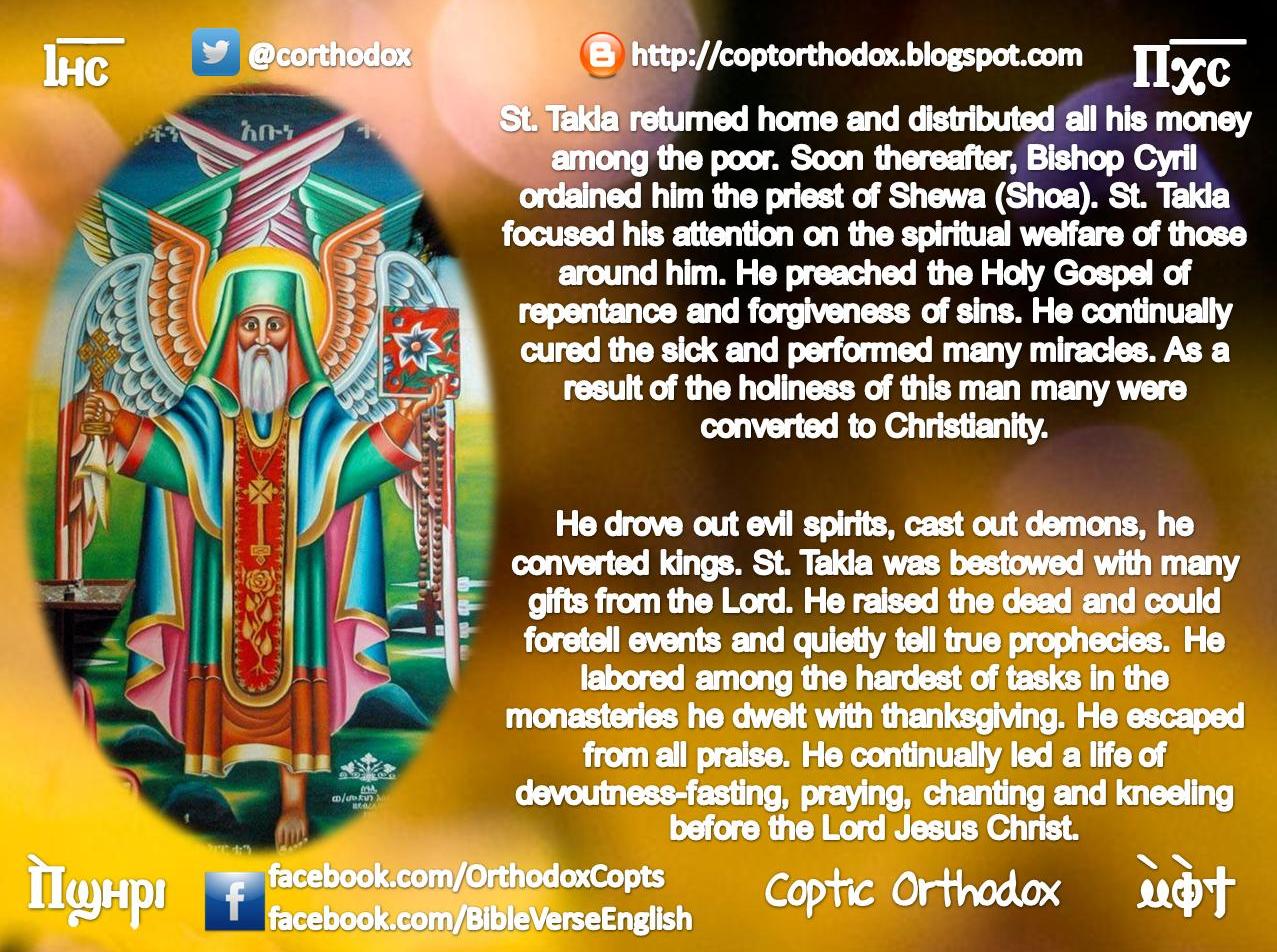
Why St. Takla's icon depicts him with six wings

One of the most famous of stories related to this saint is of his abiding in the Monastery of Abba Aragawi at the top of a very high, steep mountain. After living some time at this remote monastery, an angel of the Lord appeared to St. Takla and told him to go down to the base of the mountain and dwell in a cave to be found there. He bid the abbot of the monastery and the monks farewell, requesting their prayers and began his descent from the top of the towering mountain. As was the custom, the monks tied the saint with a rope to aid in his descent from the peak of the mountaintop. The rope broke suddenly and the monks feared the worst. Instantly and miraculously, six wings appeared from the saint and flew him safely and swiftly to the base of the mountain. Due to this miracle St. Takla's icon features him with six beautiful white wings like the Cherubim.


St. Takla Haymanot

St. Tekla Haymanot

St. Teckle Haimanout


Abuna Takla Haimanot
 

Share

Sunday, November 2, 2014

The Martyrdom of Saint Luke the Evangelist


On this day, St. Luke the Evangelist and physician, was martyred. He was one of the 70 disciples mentioned in the tenth chapter of his gospel. He accompanied the Apostles Peter and Paul and wrote their account.

After the martyrdom of these two Apostles, he went through Rome preaching. Those who worshipped idols and the Jews in Rome agreed among themselves and went to Nero the Emperor accusing St. Luke of attracting many men to his teaching with his sorcery. Nero commanded that St. Luke be brought before him. When St. Luke knew that, he gave all the books he had to a fisherman and told him, "Take these and keep them for they will be useful to you and will show you God's way."

When St. Luke came before Nero the Emperor, the Emperor asked him, "How long will you lead the people astray?" St. Luke replied, "I am not a magician, but I am an Apostle of the Lord Jesus Christ, the Son of the Living God." The Emperor commanded his men to cut off his right hand saying, "Cut off this hand which wrote the books." The saint replied to him, "We do not fear death, nor the departure from this world, and to realize the power of my Master." He took up his severed hand and made it reattach to its proper place, then he separated it. Those who were present marvelled and the head of the Emperor's cabinet and his wife believed as well as many others and it was said that they numbered 276. The Emperor wrote their decree and ordered that their heads be cut off together with that of the Apostle St. Luke; thus their martyrdom was completed.

They placed the body of the saint in a hair sack and cast it in the sea. By God's will, the waves of the sea brought it to an island. A believer found it, took it and buried it with great honor. This saint wrote the Gospel bearing his name and the "Acts of the Apostles" addressing his words to his disciple Theophilus who was a gentile.

His blessings be upon us and Glory be to our God, forever. Amen.

Coptic Orthodox Synaxarium


Share

Tuesday, May 20, 2014

Commemoration of Consecration of The Church of St. Demiana


On this day, the church commemorates the consecration of the church of the virgin St. Demiana. This pure and fighting virgin was the daughter of Mark, who was the governor of El-Borollus, El-Zaafran and the valley of Saisaban. She was the only child of her parents. When she was one year old, her father took her to the church that was in the monastery of El-Maima. He offered gifts there so that God might bless this daughter and keep her safe Him.

When she was fifteen years old, her father wanted to get her married. She refused and told him that she had vowed herself a bride for the Lord Christ. When she found that her father was pleased of her decision, she asked him to build her an isolated palace, so that she could worship God with her virgin friends, and right away he did what she asked. He built the palace where she and the forty virgins lived in. They spent their time by reading the Holy Bible and praying fervently to God.

Shortly after, Emperor Diocletian sent for Mark her father and ordered him to worship the idols, but he refused at first. However, after some persuasion, Mark obeyed him and worshipped the idols, forsaking the creator of the universe.

When Mark returned, and St. Demiana knew of what her father had done, she rushed to meet him without a greeting saying: "What have I heard about you? I wished I have Heard the news of your death, and not knowing that you have forsaken God who have created you and worshipped what is made by hands. If you insist on what you have done and you do not relent by denouncing the idols, you are not my father, and I am not your daughter." She also said to him: "It is better for you, O my father, that you die a martyr and live with Christ in heaven forever, than you live as a pagan here and die with the devil in hades forever." Then she left him. Her father was moved by what she said and wept bitterly. He went in hurry to Diocletian and confessed the Lord Christ before him. When Diocletian could not change his mind, he ordered him to be beheaded.

When Diocletian knew that the one who turned Mark away from worshipping the idols was his daughter Demiana, he sent to her a prince to persuade her at first, and if she did not obey, he would cut off her head. The Prince came to her with an entourage of one hundred soldiers armed with all instruments of torture. When he arrived to her palace, he went to her and said: "I am an envoy sent by Emperor Diocletian. I came to ask you, according to his orders, to worship his gods, so he might grant you whatsoever you wish." St. Demiana shouted at the prince saying: "Curse the messenger and he who sent him. Are you not ashamed to call stones and wood gods that only dwelt by devils? There is no other God in heaven or on earth except the one God, the Father, the Son and the Holy Spirit, the Creator, Who has no beginning and no end, the Omnipresent, and the Omniscient God, who will throw you in hell for eternal condemnation. As for me, I worship my Lord and Savior Jesus Christ and His Good Father and the Holy Spirit, the Holy Trinity. I profess Him, depend on Him, and in His name I die and by Him I will live forever." The Prince became angry of what she said, and ordered her to be placed in the body press. Her blood poured out on the ground, and the virgins were standing, weeping for her. Then they put her in prison, where the angel of the Lord appeared to her and touched her body with his celestial wings and healed her from all her wounds.

The Prince was creative in the ways he tortured St. Demiana, sometimes by rending her flesh, or placing her in boiling grease and oil. In all that, the Lord strengthened her and raised her up whole. When the Prince saw that his efforts were of no avail and the steadfastness of this pure virgin, he ordered her to be beheaded with all the virgins with her. They all received the crowns of martyrdom. (The account of her martyrdom is mentioned in the 13th day of Tubah)

The Prince returned to Antioch, the city of the Emperor. The faithful came and gathered the bodies of the martyrs and kept them until the end of the days of persecution and the reign of the righteous Emperor the Christ-loving Constantine the great. He ordered to destroy the idol temples and built many churches after the names of the martyrs. He gathered the bodies of the martyrs in every place and placed them in the churches. He endowed the churches with the necessary income to maintain them.

When Constantine knew of all what had happened to St. Demiana, and how she endured for a long time in the valley of El-Saisaban, he delegated his blessed mother St. Helena to take burial clothing, go to El-Zaafran, and build a church in the name of St. Demiana and the forty virgins, there.

St. Helena came to the valley, went up to the palace, and found that the bodies were unharmed. She found St. Demiana in the place where she used to sit and around her the forty virgins. She kissed the body, taking the blessing of the Saint and wrapped the bodies with expensive shrouds. She gathered the craftsmen and architects, tore down the palace, and built instead a well built tomb (Cellar) underground. She laid the body of St. Demiana on an ivory bed, and covered her with a precious bedspread and laid the forty virgins around her in it. Then she built a small and beautiful church which had one dome on the top of it. The church was consecrated by Pope Alexandros, the nineteenth Patriarch of Alexandria, on the 12th. of Bashans. He also ordained a saintly bishop, priests, and deacons to serve in the church day and night in prayers.

The bishop of this area, El-Zaafran and El-Borollus, was martyred and his body was placed in this church among the bodies of other martyrs. Abba Yoannis, Bishop of El Borullus, said in his book, The History of the Church: "The church was destroyed in the 8th. century by one of the Arab rulers, who built in its place a palace for his residence."

At this time, the water of the Mediterranean sea flooded the Delta of the Nile river until it reached the city of Samannoud to the western side of the church that called "Zion" by the old citadel. This flooding was caused by the deterioration of the barrier, which held back the sea water. When the news reached the king Hassan Ibn Atahia, he was saddened because this district brought the government much money because it was rich in its highly priced aromatic plants. One of his close aids, who was a Jew, told the king to bring the Patriarch of the Copts and order him to pray in faith to return everything to where they were before the flood.

God assisted this Patriarch through the help of one of the holy men who was known as El-Toffahi in this trying time. The Patriarch prayed in the church at Samannoud in the presence of the king. Then the Patriarch went out of the church raising the Cross. The people were saying Lord have mercy and the holy man, El-Toffahi, behind him. Instantly, the water receded to the north before them. The Patriarch, behind him El-Toffahi, the priests, the people, and the king continued to walk until they arrived to El-Zaafran where they erected tents for the king beside the destroyed palace, under which the body of St. Demiana along with the bodies of the forty martyrs were kept. The Patriarch prayed and knelt to the ground with all the people with him. At this moment, a great miracle and sign occurred that amazed everyone. A great wind blew in the sea and the waves became very high, which caused great quantities of sand to form a great barrier with the power of God almighty which was stronger than the original one. Then the winds calmed down.

The Patriarch returned to the king, who received him with honor and told him: "O Patriarch, ask from me, something to do for you." The Patriarch replied: "I need your assistance in building a church in this place because it contains the bodies of Saints who were martyred, for they refused to worship idols. The king ordered that the place be cleaned. The Patriarch opened the door of the cellar, went down, and found the forty bodies of the martyrs around the bed of St. Demiana. The king ordered at once to build a church with one dome, which was consecrated by the Patriarch on the 12th day of Bashans.

The news of this church spread in all the country and the people came with their offerings to it. The church was consecrated for the first time during the reign of Constantine and the second time was on this day.

The king ordered that no one disturb the Copts, so it was a peaceful and tranquil time in all Egypt. The king returned to his palace in Misr (Cairo) and always asked the Patriarch to visit him periodically. He came to visit the king with great honor till his departure.

The king of Egypt at that time was Hassan Ibn Atahia, who was just, loved the churches, and treated the bishops and the monks with great respect. He loved Pope Khail the first, the forty-sixth Patriarch of Alexandria (743 - 767 A.D.), and came often to visit him. He discussed the affairs of the country with him.

May the prayers of St. Demiana be with us. Amen.

 
Share

Saturday, February 8, 2014

The Departure of the Great Saint Anba Paul, the First Hermit


On this day of the year 341 A.D., the great saint Anba Paul, the first hermit, departed. This Saint was from the city of Alexandria, and had a brother whose name was Peter.

After the departure of their father, they divided the inheritance between them. When his brother took the greater share, Paul's feelings were hurt, by his brother's action. He said to his brother, "Why don't you give me my rightful share of the inheritance of my father?" Peter responded, "You are a young man, and I am afraid that you might squander it. As for me, I will keep it for you."

When they did not agree with each other, they went to the governor to judge between them. On their way, they saw a funeral procession. Paul asked one of the mourners about the deceased man. Paul was told that he was one of the noble and rich people of the city, and that he left his riches and his wealth behind, and that they were taking him to bury him with only his garment.

St. Paul sighed in his heart and said to himself, "What do I have to do then with all the money of this temporal world which I shall leave naked?" He looked to his brother and said to him, "My brother, let us return, for I shall not ask you for anything, not even for what is mine."

On their way back, Paul left his brother and went on his way until he came out of the city. Paul found a grave where he stayed for three days praying to the Lord Christ to guide him to what pleases Him. As for his brother, he searched for Paul diligently and when he did not find him, he was very sorry for what he had done.

God sent St. Paul an angel who took him out of this place, and walked with him until they reached the eastern inner wilderness. He stayed there for 70 years, during which he saw no one. He put on a tunic made of palm tree fiber. The Lord sent him a raven every day with a half loaf of bread.

When the Lord wanted to reveal the holiness of St. Paul and his righteousness, He sent His angel to St. Antony (Antonius) the Great, who thought that he was the first to dwell in the wilderness. The angel told St. Antony, "There is a man who lives in the inner wilderness; the world is not worthy of his footsteps. By his prayers, the Lord brings rain and dew to fall on the earth, and bring the flood of the Nile in its due season."

When St. Antony heard this, he rose right away and went to the inner wilderness, a distance of one day's walk. God guided him to the cave of St. Paul. He entered, and they bowed to each other, and sat down talking about the greatness of the Lord.

In the evening, the raven came bringing a whole loaf of bread. St. Paul said to St. Antony, "Now, I know that you are one of the children of God. For 70 years, the Lord has been sending to me everyday, half a loaf of bread, but today, the Lord is sending your food also. Now, go and bring me back in a hurry the tunic that Emperor Constantine had given to Pope Athanasius."

St. Antony went to St. Athanasius, and brought the tunic from him and returned to St. Paul. On his way back, he saw the soul of St. Paul carried by the angels up to heaven. When he arrived to the cave, he found that St. Paul had departed from this world. He kissed him, weeping, and clothed him in the tunic that he asked for, and he took his fiber tunic.

When St. Antony wanted to bury St. Paul, he wondered how could he dig the grave? Two lions entered the cave, bowed their heads before the body of St. Paul, and shook their heads as if they were asking St. Anthony what to do. St. Antony knew that they were sent from God. He marked the length and width of the body on the ground, and they dug the grave with their claws, according to St. Antony's directions. St. Anthony then buried the holy body, and went back to Pope Athanasius and told him what had happened. St. Athanasius sent men to bring St. Paul's body to him. They spent several days searching in the mountains, but they could not find the place of his grave. St. Paul appeared to the Pope in a vision and told him that the Lord would not allow the revelation of the location of his body. He asked the Pope not to trouble the men, but to have them brought back.

Pope Athanasius used to put the palm fiber tunic on three times a year during the Divine Liturgy. One time, he wanted to let the people know about the holiness of the owner of that tunic. He put it over a dead man, and the dead man rose up instantly. The news of this miracle spread all around the land of Egypt.

His prayers be with us all. Amen.


You may View

Abba Pawli - St. Paul - Hermit
http://orthodoxsocities.blogspot.com/2014/02/abba-pawli-st-paul-hermit.html


Share

Wednesday, January 29, 2014

The Dormition of Our Lady, the Virgin Mary, the Theotokos


On this day, Our Lady, the all pure, Virgin St. Mary, the Mother of God, departed. As she was always praying in the holy sepulchre (sepulcher), the Holy Spirit informed her that she was about to depart from this temporal world. When the time of her departure arrived, the virgins of the Mount of Olives came to her, with the apostles, who were still alive, and they surrounded her bed. The Lord Jesus Christ, to Whom is the glory, with a host of thousands and thousands of angels came to her and comforted her and told her about the eternal joy that was prepared for her, and she rejoiced. The apostles and the virgins asked her to bless them. She stretched her hand and blessed them all, and she gave up her pure spirit in the hand of her Son and God, and He took her spirit to the heavenly mansions.

The apostles prepared the body in a fitting manner and carried it to Gethsemane. Some of the Jews blocked their way to prevent them from burying the body. One of the Jews seized the coffin with his hands, which were separated instantly from his body and they remained attached to the coffin. He regretted his evil deed and wept bitterly. Through the supplications of the saintly apostles, his hands were reattached to his body, and he believed in the Lord Christ. When they placed the body in the tomb, the Lord hid it from them.

St. Thomas the Apostle was not present at the time of St. Mary's departure. He wanted to go to Jerusalem and a cloud carried him there. On his way, he saw the pure body of St. Mary carried by the angels and ascended to heaven with it. One of the angels told him, "Make haste and kiss the pure body of St. Mary," and he did.

When St. Thomas arrived where the disciples were, they told him about St. Mary's departure and he said to them, "You know how I conducted myself at the resurrection of the Lord Christ, and I will not believe unless I see her body." They went with him to the tomb, and uncovered the place of the body but they did not find it, and everyone was perplexed and surprised. St. Thomas told them how he saw the holy body and the angels that were ascending with it. They heard the Holy Spirit saying to them, "The Lord did not will to leave her body on earth." The Lord had promised his pure apostles to let them see her in the flesh once again. They were waiting for this promise to be fulfilled, until the 16th day of the month of Misra, when the promise was fulfilled and they saw her.

The years of her life on earth were 60 years. She was 12 years old when she left the temple. She spent 34 years in Joseph's house, until the Ascension of the Lord, and 14 years with St. John the Evangelist, according to the commandment of the Lord which he told her at the cross, "Behold, this is your son," and to St. John, "Behold, this is your mother."

Her intercession and blessings be with us. Amen.


Share

Thursday, August 22, 2013

The Assumption Of the Blessed Virgin Mary


On this day, was the assumption of the body of our pure Lady St. Mary, the Mother of God. While she was keeping vigil, praying in the Holy Sepulcher, and waiting for the happy minute of her liberation from the bonds of the flesh, the Holy Spirit informed her of her forthcoming departure from this vain world. When the time drew near, the disciples and the virgins of the Mt. of Olives (Zeiton) came and the Lady was lying on her bed. Our Lord, surrounded by thousands and thousands of angels, came to Her. He consoled her, and announced her with the everlasting joy which was prepared for Her. She was happy, and she stretched out her hands, blessed the Disciples, and the Virgins. Then, she delivered up her pure soul in the hand of her Son and God, Jesus Christ, Who ascended her to the higher habitations. As of the pure body, they shrouded it and carried it to Gethsemane.

On their way, some of the Jews blocked the way in the face of the disciples to prevent the burial. One of them seized the coffin. His hands were separated from his body, and remained hanging until he believed and repented for his mischievous deed. With the prayers of the holy disciples, his hands were reattached to his body as they had been before.

St. Thomas was absent at the time of St. Mary's departure, but he came after the burial. On his way back to Jerusalem, St. Thomas saw angels carrying St. Mary's pure body and ascending with it to heaven, and one of the angels said to him, "Hurry and kiss the pure body of St. Mary." When he arrived to the disciples, they informed him about St. Mary's departure. He told them, "I will not believe, unless I see her body, as you all know how I did doubt the Resurrection of our Lord Jesus Christ before." They took him to the tomb, to uncover the body but they did not find it, and they were perplexed and amazed. St. Thomas told them how he saw the pure body ascending to heaven, carried by angels.

The Holy Spirit then told them, "The Lord did not Will to leave Her Holy body on earth." The Lord had promised his pure apostles that they would see her in flesh another time. They were waiting for the fulfillment of this truthful promise, until the sixteenth day of the month of Misra, when the promise of seeing her was fulfilled. They saw her sitting on the right hand of her Son and her Lord, surrounded by the angelic Host, as David prophesied and said, "At your right hand stands the queen." (Psalm 45:9) St. Mary's life on earth was sixty years. She spent twelve years of them in the temple, thirty years in the house of the righteous St. Joseph, and fourteen years in the care of St. John the Evangelist, as the Lord commanded her saying, "Woman behold your Son," and to St. John, "Behold your Mother."

May Her intercession be with us. Amen.

Coptic Synaxarium (Mesra 16, August 22)


Share

Thursday, July 12, 2012

Martyrdom of Saints Peter and Paul, The Apostles - The Coptic Synaxarium Readings


Martyrdom of Saints Peter and Paul, the Apostles
The Coptic Synaxarium Readings

On this day, the two great saints Peter and Paul, were martyred. St. Peter was from Bethsaida, and he was a fisherman. The Lord chose him on the second day of His baptism after He chose Andrew his brother. He had fervent faith and strong zeal.

When the Lord asked His disciples: "Who do men say that I am?" So they answered, "Some say John the Baptist, some Elijah, and others Jeremiah or one of the prophets." ... Simon Peter answered and said, "You are the Christ, the Son of the living God." 
(Mat. 16:13-20)

After he received the grace of the Holy Spirit, he went around in the world preaching of the crucified Christ, and he converted many to the faith. God wrought great and innumerable signs and wonders by his hands. He wrote two catholic Epistles to the believers.

When he came to the city of Rome, he found there St. Paul the Apostle. Through their preaching, most of the people of Rome believed, so Nero seized Peter and commanded to crucify him. Peter asked them to crucify him head downwards, and he delivered up his soul into the hand of the Lord.

As for St. Paul the Apostle, he was born in Tarsus two years before the advent of the Savior. He was a Jew, of the tribe of Benjamin, a Pharisee, the son of a Pharisee.
He was well learned in the Law of the Torah, and he was jealous for it. He persecuted the Christians. When they stoned St. Stephen, Paul was guarding the clothes of those who were stoning him. He took from Caiaphas, the high priest, letters to the synagogues of Damascus, to bind the Christians and bring them to Jerusalem.

As he journeyed, he came near Damascus, and suddenly a light shone around him from heaven. Then he fell to the ground, and heard a voice saying to him, "Saul, Saul, why are you persecuting Me?"  And he said, "Who are You, Lord?" And the Lord said, "I am Jesus, whom you are persecuting. It is hard for you to kick against the goads."  Then He ordered him to go to Ananias in Damascus, who baptized him, and he received his sight at once.

He was filled by the grace of the Comforter, and he proclaimed boldly the Faith. He went around in the world preaching of the crucified Christ. He suffered much beatings, imprisonment, and was bound with fetters, some of which are mentioned in the book of the Acts of the Apostles and in his Epistles.
He went to Rome and proclaimed the Faith there and many believed by his hands. He wrote for them the Epistle to the Romans which was the first of his fourteen Epistles.

Finally, Nero seized him, tortured him severely and ordered his head cut off.

While St. Paul was passing along with the executioner, he met a damsel who was a kinswoman of the Emperor Nero, and who had believed through him. She walked along with St. Paul, weeping, to where they carried out the sentence. He comforted her and asked her for her veil. He wrapped his head with the veil, and asked her to return back.

The executioner cut off his head and left it wrapped in the veil of the young girl, and that was in the year 67 A.D. The young girl met the executioner on his way back to the Emperor, and asked him about Paul and he replied, "He is lying where I left him and his head is wrapped in your veil." She told him, "You are lying, for he and Peter had just passed by me, they were arrayed in the apparel of kings, and had crowns decorated with jewels on their heads, and they gave me my veil, and here it is." She showed it to the executioner, and to those who were with him. They marveled, and believed on the Lord Christ.

God wrought by the hands of Peter and Paul many great signs and wonders, that they even carried the sick out into the streets ... that as Peter came by ... his shadow might fall on them ... and they were all healed. (Acts 5:15) 

The handkerchiefs or aprons were brought from Paul's body to the sick, and the diseases left them and the evil spirits went out of them. (Acts 19:12)

May their prayers be with us ... Glory be to God forever. Amen.


Share

Facebook Comments

Word of the Day

Quote of the Day

Article of the Day

This Day in History

Today's Birthday

In the News