Showing posts with label Disciples. Show all posts

Sunday, May 31, 2015

The Sending of the Holy Spirit


When the Lord told his disciples to go and teach all nations and baptise them in the name of the Father and of the Son and of the Holy Spirit, he conferred on them the power of giving men new life in God.

He had promised through the prophets that in these last days he would pour out his Spirit on his servants and handmaids, and that they would prophesy. So when the Son of God became the Son of Man, the Spirit also descended upon him, becoming accustomed in this way to dwelling with the human race, to living in men and to inhabiting God’s creation. The Spirit accomplished the Father’s will in men who had grown old in sin, and gave them new life in Christ.

Luke says that the Spirit came down on the disciples at Pentecost, after the Lord’s ascension, with power to open the gates of life to all nations and to make known to them the new covenant. So it was that men of every language joined in singing one song of praise to God, and scattered tribes, restored to unity by the Spirit, were offered to the Father as the first-fruits of all the nations.

This was why the Lord had promised to send the Advocate: he was to prepare us as an offering to God. Like dry flour, which cannot become one lump of dough, one loaf of broad, without moisture, we who are many could not become one in Christ Jesus without the water that comes down from heaven. And like parched ground, which yields no harvest unless it receives moisture, we who were once like a waterless tree could never have lived and borne fruit without this abundant rainfall from above. Through the baptism that liberates us from change and decay we have become one in body; through the Spirit we have become one in soul.

The Spirit of wisdom and understanding, the Spirit of counsel and strength, the Spirit of knowledge and the fear of God came down upon the Lord, and the Lord in turn gave this Spirit to his Church, sending the Advocate from heaven into all the world into which, according to his own words, the devil too had been cast down like lightning. If we are not to be scorched and made unfruitful, we need the dew of God. Since we have our accuser, we need an advocate as well. And so the Lord in his pity for man, who had fallen into the hands of brigands, having himself bound up his wounds and left for his care two coins bearing the royal image, entrusted him to the Holy Spirit. Now, through the Spirit, the image and inscription of the Father and the Son have been given to us, and it is our duty to use the coin committed to our charge and make it yield a rich profit for the Lord.

Irenaeus of Lyons


Share

Tuesday, August 19, 2014

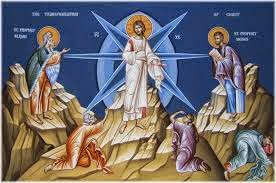
The Transfiguration of our Lord Jesus Christ


By St. Cyril of Alexandria 

Luke 9:27-36

THOSE who are skilful in the combat rejoice when the spectators clap their hands, and are roused to a glorious height of courage by the hope of the chaplets of victory: and so those whoso desire it is to be counted worthy of the divine gifts, and who thirst to be made partakers of the hope prepared for the saints, joyfully undergo combats for piety’s sake towards Christ, and lead elect lives, not setting store by a thankless indolence, nor indulging in a mean timidity, but rather manfully resisting every temptation, and setting at nought the violence of persecutions, while they count it gain to suffer in His behalf. For they remember that the blessed Paul thus writes, “The sufferings of this present time are not worthy of the glory that is about to be revealed in us.”

Observe, therefore, how perfectly beautiful is the method which our Lord Jesus Christ uses here also for the benefit and edification of the holy Apostles. For He had said unto them, “Whosoever will come after Me, let him deny himself and take up his cross every day, and follow Me. For he that will save his life shall lose it; and he that will lose his life for My sake shall find it.” The commandment is indeed both for the salvation and honour of the saints, and the cause of the highest glory, and the means of perfect joy: for the choosing to suffer for the sake of Christ is not a thankless duty, but on the contrary makes us sharers in everlasting life, and the glory that is prepared. But as the disciples had not yet obtained power from on high, it probably occasionally happened, that they also fell into human weaknesses, and when thinking over with themselves any such saying as this, may have asked “how does a man deny himself?” or how having lost himself does he find himself again? And what reward will compensate those who thus suffer? Or of what gifts will they be made partakers? To rescue them therefore from such timid thoughts, and, so to speak, to mould them unto manliness, by begetting in them a desire of the glory about to be bestowed upon them, He says, “I say unto you, there are some of those standing here, who shall not taste of death until they have seen the kingdom of God.” Does He mean that the measure of their lives will be so greatly prolonged as even to reach to that time when He will descend from heaven at the. consummation of the world, to bestow upon the saints the kingdom prepared for them? Even this was possible for Him: for He is omnipotent: and there is nothing impossible or difficult to His all-powerful will. But by the kingdom of God He means the sight of the glory in which He will appear at His manifestation to the inhabitants of earth: for He will come in the glory of God the Father, and not in low estate like unto us. How therefore did He make those who had received the promise spectators of a thing so wonderful? He goes up into the mountain taking with Him three chosen disciples: and is transformed to so surpassing and godlike a brightness, that His garments even glittered with rays of fire, and seemed to flash like lightning. And besides, Moses and Elijah stood at Jesus’ side, and spake with one another of His departure, which He was about, it says, to accomplish at Jerusalem: by which is meant the mystery of the dispensation in the flesh; and of His precious suffering upon the cross. For it is also true that the law of Moses, and the word of the holy prophets, foreshewed the mystery of Christ: the one by types and shadows, painting it, so to speak, as in a picture; while the rest in manifold ways declared beforehand, both that in due time He would appear in our likeness, and for the salvation and life of us all, consent to suffer death upon the tree. The standing, therefore, of Moses and Elijah before Him, and their talking with one another, was a sort of representation, excellently displaying our Lord Jesus Christ, as having the law and the prophets for His body guard, as being the Lord of the law and the prophets, and as foreshown in them by those things which in mutual agreement they before proclaimed. For the words of the prophets are not at variance with the teachings of the law. And this I imagine was what Moses the most priestly and Elijah the most distinguished of the prophets were talking of with one another.

But the blessed disciples sleep awhile, as Christ continued long in prayer:—-for He performed these human duties as belonging to the dispensation:—-and afterwards on awaking they became spectators of changes thus splendid and glorious: and the divine Peter, thinking perchance, that the time of the kingdom of God was even now come, proposes dwellings on the mountain, and says that it is fitting there should be three tabernacles, one for Christ, and the others for the other two, Moses and Elijah: “but he knew not,” it says, “what he was saying.” For it was not the time of the consummation of the world, nor for the saints to take possession of the hope promised to them; for as Paul says, “He will change our humble body into the likeness of His,—-that is, Christ’s—-glorious body.” As therefore the dispensation was still at its commencement, and not yet fulfilled, how would it have been fitting for Christ to have abandoned His love to the world, and have departed from His purpose of suffering in its behalf? For He redeemed all under heaven, by both undergoing death in the flesh, and by abolishing it by the resurrection from the dead. Peter therefore knew not what he said.

But besides the wonderful and ineffable sight of Christ’s glory, something else was done, useful and necessary for the confirmation of their faith in Him: and not for the disciples only, but even for us too. For a voice was given forth from the cloud above, as from God the Father, saying: “This is My beloved Son, hear Him. And when there was the voice,” it says, “Jesus was found alone.” What then will he who is disputatious and disobedient, and whose heart is incurable, say to these things? Lo! Moses is there, and does the Father command the holy apostles to hear him? Had it been His will that they should follow the commandments of Moses, He would have said, I suppose, Obey Moses; keep the law. But this was not what God the Father here said, but in the presence of Moses and the prophets, He commands them rather to hear Him. And that the truth might not be subverted by any, affirming that the Father rather bade them hear Moses, and not Christ the Saviour of us all, the Evangelist has clearly marked it, saying, “When there was the voice, Jesus was found alone.” When therefore God the Father, from the cloud overhead, commanded the holy apostles, saying, “Hear Him,” Moses was far away, and Elijah too was no longer nigh; but Christ was there alone. Him therefore He commanded them to obey.

For He also is the end of the law and the prophets: for which reason He cried aloud to the multitudes of the Jews: “If ye had believed Moses, ye would have believed Me also: for he wrote of Me.” But as they persevered even unto the end in despising the commandment given by most wise Moses, and in rejecting the word of the holy prophets, they have justly been alienated and expelled from those blessings that were promised to their fathers. For “obedience is better than sacrifices, and to hearken than the fat of rams,” as the Scripture saith. And thus much then of the Jews: but upon us who have acknowledged the revelation, all these blessings have necessarily been bestowed, by means of and as the gift of the same Christ: by Whom and with Whom, to God the Father be praise and dominion, with the Holy Spirit, for ever and ever. Amen.
 
Homily  of St. Cyril of Alexandria 


Share

Monday, July 14, 2014

The Apostles Feast - HH Pope Shenouda III


But you shall receive power when the Holy Spirit has come upon you; 
and you shall be witnesses to Me in Jerusalem, 
and in all Judea and Samaria, and to the end of the earth. 
Acts 1:8


The Church celebrates the memory of the martyrdom of St. Peter and St. Paul on the 5th of Abib, which is the 12th of July. This feast is called in our Church by the name of "the Feast of the Apostles." Its date is unchanged in every year.
The Church venerates these two apostles very profoundly; and raises them and honors them exceedingly; especially in the prayer of the partition" or "the division" which pertains to the fast of the apostles and to the feast of the apostles, which we pray during the holy mass.

These two saints represent two distinguished kinds as regards the personality, the mission, and the style. Each one of them has distinct characteristics.

THE POINTS OF DIFFERENCE

Peter was among the first whom the Lord had chosen to work with Him.  (Matthew 10) 

And Paul was not among the twelve, and not even among the seventy apostles, but the Lord chose him lastly, after the resurrection and years after the choice of Matthias......

He did not follow Christ during His predication on earth. He rather said about that: "Then last of all He was seen by me also, as by one born out of due time. For I am the least of the apostles, who am not worthy to be called an apostle, because I persecuted the church of God."
(1 Cor. 15: 8 -9)

And although he was the last in his call, yet he "labored more abundantly than they all." (1 Cor. 15:10)  That shows that it is not a matter of precedence, but according to the amount of weariness from exertion for God.

A person may not be the most ancient among the workers in ministry, and nevertheless he may be the strongest of all the workers.
John the Baptist was not the first prophet in the Old Testament, but he was the last of them in their chronological order. Nevertheless it was said that "among those born of women there has not risen one greater than John the Baptist." (Matt. 11:11) 

The apostle Peter was a married man. It was mentioned in the Gospel that Christ healed his step-mother from fever. (Matt. 8: 14-15)  In his journeys for the predication, he wandered accompanied by his wife as a sister. (1 Cor. 9:5) 

But the apostle Paul was a virgin. (1 Cor. 7:7). He called for the preference of virginity. "But each one has his own gift from God", "as the Lord has called each one...... Let each one remain in the same calling in which he was called" (1 Cor. 7: 7,17,20). That proves that the Lord calls everybody to His service, whether they are married like Peter, or virgins like Paul.

Peter began his life with the Lord Christ with love, confidence, and faith. But on the contrary:
Paul began by enmity, as a persecutor of the Church and of everyone who followed Christ, so that the Lord, when He met him on the road to Damascus, began his conversation with him by reprimanding him saying: "Saul, Saul, why are you persecuting Me?" (Acts 9:4) Saint Peter was a simple man, a fisherman (Matt. 4:18). He was ignorant and was not instructed into culture or science. He is one of whom "God has chosen the foolish things of the world to put to shame the wise" (1 Cor. 27). It was said of him, of him and saint John, "that they were uneducated and untrained men." (Acts 4:13) But saint Paul was one of the learned of his age, who was educated at the University of Tarsus, and brought up at the feet of Gamaliel. (Acts 22:3)  He was well-known for his culture and for reading many books. (Acts 26:24) 

That shows us that the Lord equally employs everybody for His kingdom, the learned and the simple. The important thing for them is to be useful utensils for the work of His grace

The Church Rite: The Lakan

Lakan is a Syrian word means basin, and it is the pot of marble or stone placed in the third Khurs of the church where the priests pray on the water to make it a force for healing and Beatification ...

The Mass of Lakan has been Instituted to remember the baptism of Jesus and to exercise of the virtue of humility as bending to wash the feet of His disciples in the holy Thursday as well as to practice the meaning of service.

The mass of the Lakan is prayed three times per year: Epiphany – The Holy Thursday – The Feast of Apostles

H.H. Pope Shenouda III 

Share

Sunday, June 8, 2014

Pentecost - St. Ephraim The Syrian


“Now the Prophets performed all other signs; but on no occasion supplied the deficiency of members. But the deficiency of the body was reserved, that it should be supplied through our Lord; that souls might perceive that it is through Him that every deficiency must be supplied. It is meet, then, that the prudent should perceive that He Who supplies the deficiencies of the creatures, is Master of the formative power of the Creator.

But when He was upon earth, our Lord gave to the deaf and dumb, the power of hearing and of speaking tongues which they had not learned; that after He had ascended, men might understand that He gave to His disciples the power of speaking in every tongue.”

St. Ephraim the Syrian


Share

Friday, February 21, 2014

5 - HUMILITY IN THE DISCIPLES OF JESUS


But not so with you. Rather, let the greatest
among you become as the youngest,
and the leader as one who serves.
Luke 22:26


We have studied humility in the person and teaching of Jesus. Let us now look for it in the circle of His chosen companions, the twelve apostles. If, in the lack of it we find in them, the contrast between Christ and men is brought out more clearly, it will help us to appreciate the mighty change which Pentecost wrought in them. It will prove how real our participation can be in the perfect triumph of Christ's humility over the pride Satan had breathed into man.

In the Scriptures quoted from the teaching of Jesus, we have already seen what the occasions were on which the disciples had proved how entirely lacking they were in the grace of humility. Once, they had been disputing about which of them should be the greatest.  Another time, the sons of Zebedee with their mother had asked for the first places -- the seat on the right hand and the left. And, later on, at the table of the Last Supper, there was again a contention over who should be accounted the greatest.

Not that there were not moments when they indeed humbled themselves before their Lord. So it was with Peter when he cried out, "Depart from me, for I am a sinful man, O Lord!"  (Luke 5:8)  The disciples also fell down and worshipped Him who had stilled the storm. (Matt. 14:22-33)  But such occasional expressions of humility only bring out into stronger contrast the habitual state of their mind.  This state was shown in the natural and spontaneous revelation given at other times of the place and the power of self. As we study the meaning of all this will, we will learn several important lessons.

Recognizing Our Underlying Pride 

First, How much there may be of earnest and active religion while humility is still sadly lacking. See it in the disciples. There was in them fervent attachment to Jesus. They had forsaken all for Him. The Father had revealed to them that He was the Christ of God. They believed in Him, they loved Him, they obeyed His commandments. They had forsaken all to follow Him. When others went back, they clave to Him. They were ready to die with Him. But deeper down than all this there was a dark power, of the existence and the hideousness of which they were hardly conscious, which had to be slain and cast out, before they could be the witnesses of the power of Jesus to save.

It is even so still. We may find professors and ministers, evangelists and workers, missionaries and teachers, in whom the gifts of the Spirit are many and manifest, and who are the channels of blessing to multitudes, but of whom, when the testing time comes, or closer intercourse gives fuller knowledge, it is only too painfully manifest that the grace of humility, as an abiding characteristic, is scarce to be seen. All tends to confirm the lesson that humility is one of the chief and the highest graces; one of the most difficult of attainment; one to which our first and greatest efforts ought to be directed; one that only comes in power, when the fullness of the Spirit makes us partakers of the indwelling Christ, and He lives within us. 

Putting Off Personal Effort 

Second, How impotent all external teaching and all personal effort is, to conquer pride or give the meek and lowly heart. For three years the disciples had been in the training school of Jesus. He had told them what the chief lesson was He wished to teach them: "Learn of Me, for I am meek and lowly in heart."  (Matt. 11:29)

Time after time He had spoken to them, to the Pharisees, to the multitude, of humility as the only path to the glory of God. He had not only lived before them as the Lamb of God in His divine humility, He had more than once unfolded to them the inmost secret of His life: "The Son of Man came not to be served, but to serve"; (Mark 10:45);  "I am among you as one that serves." 
(Luke 22:27)

He had washed their feet, and told them they were to follow His example. And yet all had availed but little. At the Holy Supper there was still the contention as to who should be greatest. They had doubtless often tried to learn His lessons, and firmly resolved not again to grieve Him. But all in vain. To teach them and us the much needed lesson, that no outward instruction, not even of Christ Himself; no argument however convincing; no sense of the beauty of humility, however deep; no personal resolve or effort, however sincere and earnest, can cast out the devil of pride. When Satan casts out Satan, it is only to enter afresh in a mightier, though more hidden power. Nothing can avail but this, that the new nature in its divine humility be revealed in power to take the place of the old, to become as truly our very nature as that ever was.

Taking Hold of the Indwelling Christ 

Third, It is only by the indwelling of Christ in His divine humility that we become truly humble. We have our pride from another, from Adam; we must have our humility from Another too. Pride is ours, and rules in us with such terrible power, because it is ourselves, our very nature. Humility must be ours in the same way; it must be our very self, our very nature. As natural and easy as it has been to be proud, it must be, it will be, to be humble. The promise is, "Where," even in the heart, "sin abounded, grace did abound more exceedingly." (Rom. 5:20)  All Christ's teaching of His disciples, and all their vain efforts, were the needful preparation for His entering into them in divine power, to give and be in them what He had taught them to desire.

In His death He destroyed the power of the devil, He put away sin, and effected an everlasting redemption. In His resurrection He received from the Father an entirely new life, the life of man in the power of God, capable of being communicated to men, and entering and renewing and filling their lives with His divine power. In His ascension He received the Spirit of the Father, through whom He might do what He could not do while upon earth, make Himself one with those He loved, actually live their life for them, so that they could live before the Father in a humility like His, because it was Himself who lived and breathed in them. And on Pentecost He came and took possession. The work of preparation and conviction, the awakening of desire and hope which His teaching had effected, was perfected by the mighty change that Pentecost wrought. And the lives and the epistles of James and Peter and John bear witness that all was changed, and that the spirit of the meek and suffering Jesus had indeed possession of them.

What shall we say to these things? Among my readers I am sure there is more than one class. There may be some who have never yet thought very specially of the matter, and cannot at once realize its immense importance as a life question for the Church and its every member. There are others who have felt condemned for their shortcomings, and have put forth very earnest efforts, only to fail and be discouraged. Others, again, may be able to give joyful testimony of spiritual blessing and power, and yet there has never been the needed conviction of what those around them still see as wanting. And still others may be able to witness that in regard to this grace too the Lord has given deliverance and victory, while He has taught them how much they still need and may expect out of the fullness of Jesus.

To whichever class we belong, may I urge the pressing need there is for our all seeking a still deeper conviction of the unique place that humility holds in the religion of Christ, and the utter impossibility of the Church or the believer being what Christ would have them be, as long as His humility is not recognized as His chief glory, His first command, and our highest blessedness. Let us consider deeply how far the disciples were advanced while this grace was still so terribly lacking, and let us pray to God that other gifts may not so satisfy us, that we never grasp the fact that the absence of this grace is the secret cause why the power of God cannot do its mighty work. It is only where we, like the Son, truly know and show that we can do nothing of ourselves, that God will do all. 

It is when the truth of an indwelling Christ takes the place it claims in the experience of believers, that the Church will put on her beautiful garments and humility be seen in her teachers and members as the beauty of holiness. 
Humility - Andrew Murray

Share

Thursday, August 22, 2013

The Assumption Of the Blessed Virgin Mary


On this day, was the assumption of the body of our pure Lady St. Mary, the Mother of God. While she was keeping vigil, praying in the Holy Sepulcher, and waiting for the happy minute of her liberation from the bonds of the flesh, the Holy Spirit informed her of her forthcoming departure from this vain world. When the time drew near, the disciples and the virgins of the Mt. of Olives (Zeiton) came and the Lady was lying on her bed. Our Lord, surrounded by thousands and thousands of angels, came to Her. He consoled her, and announced her with the everlasting joy which was prepared for Her. She was happy, and she stretched out her hands, blessed the Disciples, and the Virgins. Then, she delivered up her pure soul in the hand of her Son and God, Jesus Christ, Who ascended her to the higher habitations. As of the pure body, they shrouded it and carried it to Gethsemane.

On their way, some of the Jews blocked the way in the face of the disciples to prevent the burial. One of them seized the coffin. His hands were separated from his body, and remained hanging until he believed and repented for his mischievous deed. With the prayers of the holy disciples, his hands were reattached to his body as they had been before.

St. Thomas was absent at the time of St. Mary's departure, but he came after the burial. On his way back to Jerusalem, St. Thomas saw angels carrying St. Mary's pure body and ascending with it to heaven, and one of the angels said to him, "Hurry and kiss the pure body of St. Mary." When he arrived to the disciples, they informed him about St. Mary's departure. He told them, "I will not believe, unless I see her body, as you all know how I did doubt the Resurrection of our Lord Jesus Christ before." They took him to the tomb, to uncover the body but they did not find it, and they were perplexed and amazed. St. Thomas told them how he saw the pure body ascending to heaven, carried by angels.

The Holy Spirit then told them, "The Lord did not Will to leave Her Holy body on earth." The Lord had promised his pure apostles that they would see her in flesh another time. They were waiting for the fulfillment of this truthful promise, until the sixteenth day of the month of Misra, when the promise of seeing her was fulfilled. They saw her sitting on the right hand of her Son and her Lord, surrounded by the angelic Host, as David prophesied and said, "At your right hand stands the queen." (Psalm 45:9) St. Mary's life on earth was sixty years. She spent twelve years of them in the temple, thirty years in the house of the righteous St. Joseph, and fourteen years in the care of St. John the Evangelist, as the Lord commanded her saying, "Woman behold your Son," and to St. John, "Behold your Mother."

May Her intercession be with us. Amen.

Coptic Synaxarium (Mesra 16, August 22)


Share

Facebook Comments

Word of the Day

Quote of the Day

Article of the Day

This Day in History

Today's Birthday

In the News