Showing posts with label Coptic. Show all posts

Friday, September 25, 2015

Friday Psali - Escape


Our Lord Jesus Christ, gave a sign to His servants, who do fear him, to escape from the face of the bows

Ⲁⲡⲉⲛⲟⲥ̅ Ⲓⲏⲥⲟⲩⲥ Ⲡⲓⲭⲣⲓⲥⲧⲟⲥ : ϯⲛ̀ⲟⲩⲙⲏⲓⲛⲓ ⲛ̀ⲛⲉϥⲉ̀ⲃⲓⲁⲓⲕ : ⲛⲏⲉ̀ⲧⲉⲣϩⲟϯ ϧⲁ ⲧⲉϥϩⲏ : ⲉⲑⲣⲟⲩⲫⲱⲧ ⲉ̀ⲃⲟⲗ ϧⲁ ⲧ̀ϩⲏ ⲙ̀ⲡ̀ϩⲟ ⲛ̀ⲟⲩⲫⲓϯ


Share

Sunday, August 30, 2015

St. Takla Haymanot of Ethiopia


The great saint, Abba Takla Haymanot has a very prominent position in the Coptic Orthodox Church. The church celebrates an annual feast to commemorate the greatness of this Ethiopian saint (the saint's departure date/feast occurs on the 24th day of Mesra according to the Coptic calendar = Nehasse 24 according to the Ethiopian calendar = THE TWELVETH MONTH = August 30/31).

Life, ministry and miracles

His father was an Ethiopian priest who loved Archangel Michael and his mother was a rich and righteous woman who also loved Archangel Michael. Together, they always celebrated the archangel's feast on the twelfth of each month. After many years of prayer and supplications a son, "Feseha Zion" (the joy of Zion) was born into this family, for St. Takla's mother was barren until his birth.
The tidings of Archangel Michael were fulfilled when he said to Tsega Ze-Ab, Feseha Zion's father, "You will be the father of a child who will be an apostle in Ethiopia." His parents were overjoyed with his birth and celebrated by having a feast inviting the poor. Three days after his birth, the Holy Spirit descended upon Fesha Zion and the infant opened his mouth and said, "One is the Holy Father. One is the Holy Son. One is the Holy Spirit."

Since childhood, Feseha Zion performed many miracles. One such famous miracle occurred at the age of eighteen months. A famine had spread throughout the land of his family. As a result of the famine, Tsega Ze-Ab and his wife had nothing to celebrate the feast of their beloved Archangel Michael.

One day while Fesha Zion was being nursed he pointed to the flour basket, which was completely empty. His devout mother brought it to him and immediately when he touched the basket it became filled with flour. Basket after basket was placed before him until twelve overflowed with flour. She then decided to bring the oil jar to him. Fesha Zion placed his hand inside the jar and made the sign of the cross. Oil began to fill the jar. From this jar the mother poured oil into other jars until there was plenty for their monthly agape for the needy in honor of Archangel Michael.

When he was fifteen years old his reverent father took him to the Bishop of Amhara, Bishop Kyrillos, who saw a vision from God to ordain Feseha Zion a deacon. As a deacon he continued to perform miracles and began to heal the sick. Many confessed him to be a god, but he told them that only the One True God is worthy of honor, praise and worship.
One day while hunting with friends, Archangel Michael appeared unto deacon Feseha Zion and told him to dedicate the rest of his life to saving people's souls. The Archangel further told him that God would bestow upon him the ability to cure many illnesses, raise the dead, and cast out evil spirits in His Holy Name. It was then that Archangel Michael changed his name to Takla Haymanot, which means, "Paradise of the Father, the Son, and the Holy Spirit."

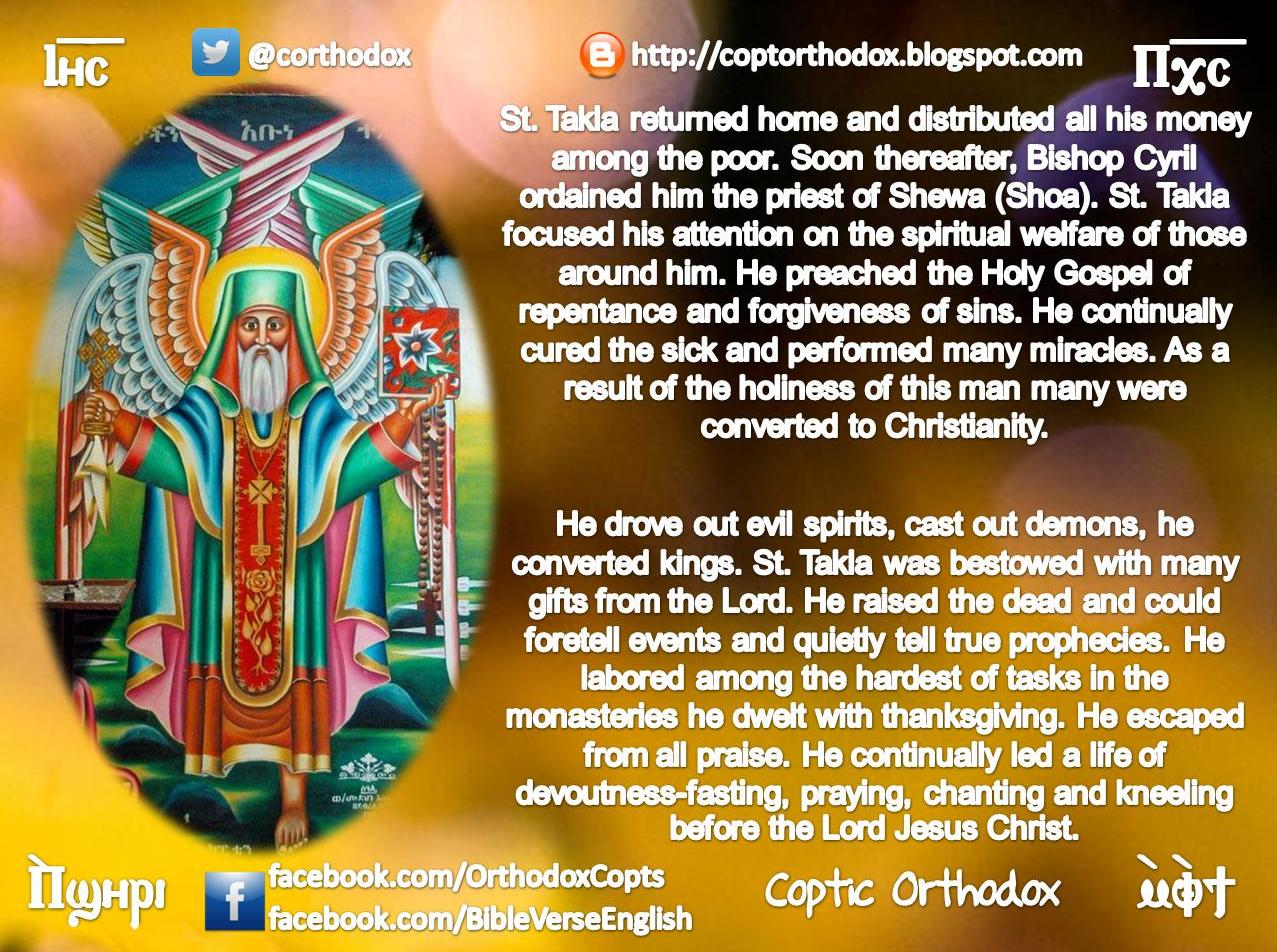
St. Takla returned home and distributed all his money among the poor. Soon thereafter, Bishop Cyril ordained him the priest of Shewa (Shoa). St. Takla focused his attention on the spiritual welfare of those around him. He preached the Holy Gospel of repentance and forgiveness of sins. He continually cured the sick and performed many miracles. As a result of the holiness of this man many were converted to Christianity.
He drove out evil spirits, cast out demons, he converted kings. St. Takla was bestowed with many gifts from the Lord. He raised the dead and could foretell events and quietly tell true prophecies. He labored among the hardest of tasks in the monasteries he dwelt with thanksgiving. He escaped from all praise. He continually led a life of devoutness-fasting, praying, chanting and kneeling before the Lord Jesus Christ.

Why St. Takla's icon depicts him with six wings

One of the most famous of stories related to this saint is of his abiding in the Monastery of Abba Aragawi at the top of a very high, steep mountain. After living some time at this remote monastery, an angel of the Lord appeared to St. Takla and told him to go down to the base of the mountain and dwell in a cave to be found there. He bid the abbot of the monastery and the monks farewell, requesting their prayers and began his descent from the top of the towering mountain. As was the custom, the monks tied the saint with a rope to aid in his descent from the peak of the mountaintop. The rope broke suddenly and the monks feared the worst. Instantly and miraculously, six wings appeared from the saint and flew him safely and swiftly to the base of the mountain. Due to this miracle St. Takla's icon features him with six beautiful white wings like the Cherubim.


St. Takla Haymanot

St. Tekla Haymanot

St. Teckle Haimanout


Abuna Takla Haimanot
 

Share

Sunday, November 2, 2014

The Martyrdom of Saint Luke the Evangelist


On this day, St. Luke the Evangelist and physician, was martyred. He was one of the 70 disciples mentioned in the tenth chapter of his gospel. He accompanied the Apostles Peter and Paul and wrote their account.

After the martyrdom of these two Apostles, he went through Rome preaching. Those who worshipped idols and the Jews in Rome agreed among themselves and went to Nero the Emperor accusing St. Luke of attracting many men to his teaching with his sorcery. Nero commanded that St. Luke be brought before him. When St. Luke knew that, he gave all the books he had to a fisherman and told him, "Take these and keep them for they will be useful to you and will show you God's way."

When St. Luke came before Nero the Emperor, the Emperor asked him, "How long will you lead the people astray?" St. Luke replied, "I am not a magician, but I am an Apostle of the Lord Jesus Christ, the Son of the Living God." The Emperor commanded his men to cut off his right hand saying, "Cut off this hand which wrote the books." The saint replied to him, "We do not fear death, nor the departure from this world, and to realize the power of my Master." He took up his severed hand and made it reattach to its proper place, then he separated it. Those who were present marvelled and the head of the Emperor's cabinet and his wife believed as well as many others and it was said that they numbered 276. The Emperor wrote their decree and ordered that their heads be cut off together with that of the Apostle St. Luke; thus their martyrdom was completed.

They placed the body of the saint in a hair sack and cast it in the sea. By God's will, the waves of the sea brought it to an island. A believer found it, took it and buried it with great honor. This saint wrote the Gospel bearing his name and the "Acts of the Apostles" addressing his words to his disciple Theophilus who was a gentile.

His blessings be upon us and Glory be to our God, forever. Amen.

Coptic Orthodox Synaxarium


Share

Saturday, February 8, 2014

The Departure of the Great Saint Anba Paul, the First Hermit


On this day of the year 341 A.D., the great saint Anba Paul, the first hermit, departed. This Saint was from the city of Alexandria, and had a brother whose name was Peter.

After the departure of their father, they divided the inheritance between them. When his brother took the greater share, Paul's feelings were hurt, by his brother's action. He said to his brother, "Why don't you give me my rightful share of the inheritance of my father?" Peter responded, "You are a young man, and I am afraid that you might squander it. As for me, I will keep it for you."

When they did not agree with each other, they went to the governor to judge between them. On their way, they saw a funeral procession. Paul asked one of the mourners about the deceased man. Paul was told that he was one of the noble and rich people of the city, and that he left his riches and his wealth behind, and that they were taking him to bury him with only his garment.

St. Paul sighed in his heart and said to himself, "What do I have to do then with all the money of this temporal world which I shall leave naked?" He looked to his brother and said to him, "My brother, let us return, for I shall not ask you for anything, not even for what is mine."

On their way back, Paul left his brother and went on his way until he came out of the city. Paul found a grave where he stayed for three days praying to the Lord Christ to guide him to what pleases Him. As for his brother, he searched for Paul diligently and when he did not find him, he was very sorry for what he had done.

God sent St. Paul an angel who took him out of this place, and walked with him until they reached the eastern inner wilderness. He stayed there for 70 years, during which he saw no one. He put on a tunic made of palm tree fiber. The Lord sent him a raven every day with a half loaf of bread.

When the Lord wanted to reveal the holiness of St. Paul and his righteousness, He sent His angel to St. Antony (Antonius) the Great, who thought that he was the first to dwell in the wilderness. The angel told St. Antony, "There is a man who lives in the inner wilderness; the world is not worthy of his footsteps. By his prayers, the Lord brings rain and dew to fall on the earth, and bring the flood of the Nile in its due season."

When St. Antony heard this, he rose right away and went to the inner wilderness, a distance of one day's walk. God guided him to the cave of St. Paul. He entered, and they bowed to each other, and sat down talking about the greatness of the Lord.

In the evening, the raven came bringing a whole loaf of bread. St. Paul said to St. Antony, "Now, I know that you are one of the children of God. For 70 years, the Lord has been sending to me everyday, half a loaf of bread, but today, the Lord is sending your food also. Now, go and bring me back in a hurry the tunic that Emperor Constantine had given to Pope Athanasius."

St. Antony went to St. Athanasius, and brought the tunic from him and returned to St. Paul. On his way back, he saw the soul of St. Paul carried by the angels up to heaven. When he arrived to the cave, he found that St. Paul had departed from this world. He kissed him, weeping, and clothed him in the tunic that he asked for, and he took his fiber tunic.

When St. Antony wanted to bury St. Paul, he wondered how could he dig the grave? Two lions entered the cave, bowed their heads before the body of St. Paul, and shook their heads as if they were asking St. Anthony what to do. St. Antony knew that they were sent from God. He marked the length and width of the body on the ground, and they dug the grave with their claws, according to St. Antony's directions. St. Anthony then buried the holy body, and went back to Pope Athanasius and told him what had happened. St. Athanasius sent men to bring St. Paul's body to him. They spent several days searching in the mountains, but they could not find the place of his grave. St. Paul appeared to the Pope in a vision and told him that the Lord would not allow the revelation of the location of his body. He asked the Pope not to trouble the men, but to have them brought back.

Pope Athanasius used to put the palm fiber tunic on three times a year during the Divine Liturgy. One time, he wanted to let the people know about the holiness of the owner of that tunic. He put it over a dead man, and the dead man rose up instantly. The news of this miracle spread all around the land of Egypt.

His prayers be with us all. Amen.


You may View

Abba Pawli - St. Paul - Hermit
http://orthodoxsocities.blogspot.com/2014/02/abba-pawli-st-paul-hermit.html


Share

Friday, November 22, 2013

Synaxarium - 12 Hatour - 21 November - 12 Hedar

Egyptian Synaxarium
THE THIRD MONTH

Hatour (Hator, Hatur, Hathor, Athor) 12 Martyr – Coptic Calendar – Martyr Calendar
21 November

Hatour 12 The Twelfth Day of the Blessed Month of Hatour

Day 12 of the Blessed Coptic Month of Hatour, may God make it always received, year after year, with reassurance and tranquility, while our sins after forgiven by the tender mercies of our God my fathers and brothers. Amen.


The Commemoration of the Honored Archangel Michael

On this day the church celebrates the feast of the honored Archangel, Michael, the head of the hosts of heaven, who stands at all times before the great throne of God, interceding on behalf of the human race.

Joshua, the son of Nun, saw him in great glory and was frightened by him and fell on his face to the earth and said to him, "Are you for us, or for our adversaries?" So he said, "No; but as Commander of the army of the Lord... I have given Jericho into your hand, ... and its king." (Joshua 5:13-15, 6:2)

The Archangel Michael was with all the saints and martyrs. He strengthened them and enabled them to endure patiently until they finished their strife. Festivals of commemoration are held and alms offered in his name on the twelfth day of each Coptic month.

An example of one of his wonders: A God-fearing man whose name was Dorotheus and his wife Theopista, held a festival of commemoration for the honored angel Michael on the twelfth day of each month. It happened that this righteous family fell on hard times and had nothing to celebrate with for the commemoration of the honored Michael. They took their clothes to sell so that they might have a feast. Michael the Archangel appeared to Dorotheus and commanded him not to sell his clothes, but to go to a sheep-master and to take from him a sheep worth one-third of a dinar.

He was also to go to a fisherman and to take from him a fish worth one-third of a dinar but Dorotheus was not to slit open the fish until he came back to him. Finally, he was to go to a flour merchant and to take from him as much flour as he needed.

Dorotheus did as the Angel commanded him. He invited the people, as was his custom, to the feast honoring the Archangel Michael. When he went into his storeroom looking for wine for the offering, he found that all the containers had been filled with wine and many other good things. He marvelled and was astonished.

After they had finished the celebration and all the people had departed, the Archangel appeared to Dorotheus as before and commanded him to cut open the belly of the fish. He found 300 dinars of gold and three coins each is a third of a dinar. He told him these three coins were for the sheep, the fish and the flour, and the 300 dinars were for him and his children. God had remembered them and their oblations and had rewarded them here, in this world and in the kingdom of heaven on the last day. As Dorotheus and his wife were astonished at this matter, the Archangel Michael said to them, "I am Michael the Archangel who delivered you from all your tribulations and I have taken your oblations and alms up to God, you shall lack no good thing whatsoever in this world." They prostrated themselves before him and he disappeared and went up into heaven. This was one of the innumerable miracles of this honored Angel.

His intercession be for us and Glory be to our God, forever. Amen.


Ethiopian Synaxarium HEDAR 12
THE THIRD MONTH
HEDAR (Hidar, Hadar) 12 - Geez (Ge'ez) Calendar – Ethiopian Calendar
(21 November)

IN THE NAME OF THE FATHER AND THE SON AND THE HOLY SPIRIT, ONE GOD. AMEN.


On this day is celebrated the festival of the honored angel, Michael the archangel, the head of the hosts of heaven, the angel who is merciful to the children of men, who standeth at all times before the great throne of God speaking on behalf of the children of man. Joshua the son of Nun saw him in great glory like unto that of a general of the king’s army, and he was frightened at him and fell down and made obeisance unto him, and said unto him, “O my lord, art thou on our side or on the side of the enemy?” And Michael said unto him, “I am the tenth of the Chiefs of the mighty armies of heaven, and this day I will give Amalek into thy hand, and I will make thee king in the city of Jericho.” This angel it was who was with all the saints and martyrs, and he made them strong and enabled them to endure patiently until they finished their strife, [and it is meet] that festivals of commemoration should be held, and gifts offered in his name on the twelfth day of each month, for he beseecheth God for the fruits of the earth, and the descent of the rains, and the [flooding of the] rivers, and for good souls so that God may make perfect all of them in integrity. Now, there was a certain God-fearing man whose name was Dorotheus, and [he had a] wife whose name was Theopista, and they were wont to make festivals of commemoration for the honored angel Michael. And all the money of these righteous folk came to an end, and they had nothing wherewith to celebrate the commemoration of the honored Michael. And because they were exceedingly sorrowful about this they took their apparel to sell so that they might make a feast. And Michael the archangel appeared unto Dorotheus and commanded him to go to a sheep-master and to take from him a sheep worth one-third of a dinar. And he was also to go to a fisherman and to take from him a fish worth one-third of a dinar, and he was not to slit the belly thereof except inside the house. And he was also to go to a flour merchant, and to take from him as much flour as he wanted. And the angel said, “Do this, and do not sell thy raiment”; and Dorotheus did as the angel commanded him. And he summoned all the people according to his custom, and he made a feast in honor of the angel Michael. When he had gone into his store-chamber to see if, peradventure, he could find a jar of wine for the Offering, he found the interior of his chamber filled with wine, and much flour; and Dorotheus was frightened and he marveled exceedingly. When he had ministered unto all the company, and they had finished the feast, and all the people had departed to their houses, the honored angel appeared unto the blessed Dorotheus in the garb wherein he had appeared unto him before, and commanded him to cut open the belly of the fish. When he had cut open the belly of the fish he found therein three hundred dinars of gold, and three third parts of a dinar. And the archangel Michael said unto Dorotheus and his wife, “Set aside these three third parts of a dinar for the sheep, the fish, and the flour, and these three hundred dinars shall be for your own needs. God hath remembered you and the alms and oblations which ye have been wont to make, and hath rewarded you for the same here in this world, and at the last day He will make you to inherit the kingdom of heaven.” And as they were frightened at this matter he said unto them, “I am Michael the archangel who hath delivered you from all your tribulation, and it is I who have loved your alms and oblations, and have taken them up to God. Henceforward ye shall lack no good thing whatsoever in this world.” And they prostrated themselves before him, and he disappeared and went up into heaven. And the angel Michael worked so many miracles that they are innumerable. Salutation to thee, O merciful angel Michael whom I have feared from my youth up; hide me under thy prayers at dawn and at eve.

And on this day also died the holy father Philotheus, the sixty-third Archbishop of the city of Alexandria. In the days of his archiepiscopate the King of Ethiopia sent a letter to George, King of Noba, and he said unto him: “God is wroth with us because of what the kings who were before us have done. For they transgressed the commandment of God, concerning Abba Peter, the bishop, whom they drove out of his diocese, and they appointed in his stead Minas the liar, in the days of Cosmas the archbishop; and, behold, six archbishops have [not] appointed a bishop to our country. And because of this our country is destroyed, and all our men and beasts have perished through famine and plague. Our enemies have risen up against us and have carried away captive many men from our country and have plundered our cities. The rain hath been withheld and it falls not, and the earth will not give her fruit, and our enemies have burnt our cities, and plundered the churches, and driven us from place to place. I beseech thee to show friendship to me in this trouble, for God’s sake, and for the sake of the Orthodox Faith. And do thou write a letter to our father the Archbishop Abba Philotheus of Egypt, and entreat him for God’s sake to absolve us, and to open up our country, and to pray for us so that God may remove from us and from our country the tribulation and trial which have come upon us, and may have compassion upon us and may appoint us a bishop, and may send him to us according to what was always done for our fathers, so that the bishop may pray to God on our behalf to remove His wrath from us. And this which I am saying unto thee I say, O my brother king, because I fear [that if a bishop be not sent] the Christian Faith will perish from among us. And behold, from that time unto this day six archbishops have been enthroned, and they have neither remembered our country nor appointed us a bishop. And we have become like unto sheep which have been turned out, and have no shepherd. Our bishops, and priests, and kings have died, and our churches have been pulled down; but we acknowledge that this tribulation hath come upon us rightly in return for what we did to our Bishop Abba Peter.” And when the letter of the King of Ethiopia came to King George in Noba, and he had read it, he was exceedingly sorry that trials and tribulation had come upon the country of Ethiopia. And straightway George, King of Noba, wrote a letter and sent it to Archbishop Abba Philotheus, and in it described to him all the trials and tribulation which had come upon the country of Ethiopia, and he besought him to have compassion upon the Christian people of the country of Ethiopia and to appoint them a bishop. When the archbishop heard this he sent straightway to the desert of Scete, to a certain righteous monk, and that monk, whose name was Abba Daniel, came forthwith to him from the monastery of Abba Macarius, and he appointed him bishop of the Ethiopians and sent him to them. And when Abba Daniel arrived in Ethiopia the people received him with great honor, and he removed the wrath [of God] from them, and he made them to conquer their enemies who had rebelled against them in times past. And all his work was right during the days of this Archbishop, Abba Philotheus, and he made manifest many signs and wonders. Salutation to Philotheus the apostle.

Salutation to ‘Admas. [Omitted in the Bodleian MS.]

[On this day died Ba’eda Maryam I, King of Ethiopia, who died on Nov. 8, A.D. 1478.]

Glory be to God Who is glorified in His Saints. Amen.

HEDAR (Hidar, Hadar) 12 - Geez (Ge'ez) Calendar – Ethiopian Calendar = Hatour (Hator, Hatur, Hathor, Athor) 12 Martyr – Coptic Calendar – Martyr Calendar

Hathor - Coptic Calendar – Martyr Calendar = Hedar - Geez (Ge'ez) Calendar – Ethiopian Calendar - Hathor also known as Hatour is the third month of the Coptic calendar. It lies between November 11 and December 9 of the Gregorian calendar. The month of Hathor is also the third month of the Season of 'Akhet' (Inundation) in Ancient Egypt, where the Nile floods cover the land of Egypt and during this month the lands become lush and green. The name of the month of Hathor comes from Hathor, the Ancient Egyptian Goddess of Beauty and Love - Gregorian Calendar equivalent: November 10 to December 9


Share

Thursday, May 10, 2012

The London School of Orthodox Christian Studies


The London School of Orthodox Christian Studies
The LSOCS

It is all too easy for us as Christians to abandon the detailed study of the faith once we are married, and have children and responsibilities as husbands and wives, parents and employees. But it is a great blessing and a joy to make time to extend our knowledge of the faith at every stage of our lives. Indeed I have learned more about our Orthodox Faith over the last years, than I have ever done before. Yet there remains always a great ocean of transforming learning and experience of which I grow more and more aware that I stand only in the shallows.

The courses provided by the London School of Orthodox Christian Studies are one small opportunity for people of all ages to continue to grow in their understanding of the Orthodox Faith. The courses in Christology, Church History and Monasticism are suitable for students of all ages and backgrounds, and are intended to have a spiritual benefit, as well as providing interesting academic study.

The courses are described at www.lsocs.co.uk and you can register for a course and begin your studies almost immediately. All of the materials are provided online so that students can study anywhere and at anytime. Why not consider registering for a course, and continuing to grow in your understanding of the Orthodox Faith today.

----------

Reflections on Eastern Monasticism

This podcast contains some brief considerations on Orthodox Monasticism. It particularly refers to the fact that monasticism in Eastern Christianity is not monolithic. It does not have exactly the same forms and practices in all places and at all times. The podcast also looks at the influence which monasticism has had, and continues to have, on the development of the spiritual life of the Orthodox Churches. There is also reference to the monastic experience in Russia and the Persian Empire.

The London School of Orthodox Christian Studies is now accepting registrations for the course on Orthodox Monasticism.


Podcast Powered By Podbean

----------

Available Courses

Orthodox Christology

Church History

Orthodox Monasticism

http://www.lsocs.co.uk/


Abouna Peter Farrington

The London School of Orthodox Christian Studies
http://lsocs.co.uk/index.php

Severus of Antioch
http://lsocs.co.uk/severus_antioch.php

Severus of Antioch - Hymns
On the Nativity of Christ who is God
http://lsocs.co.uk/severus_hymns01.php

Sample Podcasts
Hosted at Podbean
http://orthodoxfaith.podbean.com/


Share

Monday, March 26, 2012

Honoring Beloved Pope Shenouda III of the Coptic Orthodox Church in Egypt

By Michael Terheyden
        3/22/2012
        Catholic Online


He was a man of courageous Christian faith in an age which needs many more.


After battling cancer for years, the beloved leader of the Coptic Orthodox Church, his Holiness Pope Shenouda III, succumbed to his illness. Despite having to balance fierce tensions between his people, especially the youth, the Muslim People, extremist groups, and the Egyptian government, Pope Shenouda was largely seen as charismatic and highly esteemed. He was a man of courageous Christian faith in an age which needs many more.
 KNOXVILLE, TN (Catholic Online) - After battling cancer for years, on March 17, 2012, the leader of the Coptic Orthodox Church, his Holiness Pope Shenouda III, succumbed to his illness. He was 88 years old. According to one estimate, well over 100,000 mourners visited his body, which was seated on a ceremonial throne and dressed in gold and red vestments. A gold mitre was placed on his head and a gold-tipped staff placed in his hand. Pope Shenouda III led the Copts for the last 40 years of a 2000 year history that is both rich and tragic.

The Coptic Church is one of the oldest Christian churches in the world. They trace their origins back to the first century and Saint Mark, the writer of the Gospel of Mark, and the reign of the Roman emperor Nero. The Coptic Church has members in many countries throughout the world, though it is centered in Alexandria, Egypt. It is also the largest religious minority in the Middle East.

Many Copts converted to Islam after Muslim armies conquered Egypt in the seventh century because if they did not, they either had to pay excessively high taxes or they were killed. Many Copts were martyred as a result. Those who paid the tax, while they were allowed to remain Christian, lost many of their rights and were forced to live as second-class citizens. Life for the Copts improved somewhat in the 19th century, but it declined in the mid-twentieth century.

In was in this environment that Pope Shenouda served and rose in the ecclesial ranks. He was born Nazeer Gayed Roufail on August 3, 1923, in Assiut, Egypt. Nazeer became a monk at the age of 31. He was a member of the monastery of St. Anthony for six years, but he lived in a cave as a hermit, where he dedicated his time to meditation, prayer and asceticism.

He was later ordained into the diaconate in Christ and then the holy priesthood. In 1962 he was appointed to the bishopric of Christian Education and served as Dean of the Coptic Orthodox Theological Seminary, and he was given the name Shenouda, after the renowned Coptic scholar and writer Saint Shenouda the Archimandrite. Then, on November 14, 1971, he was elected as the 117th head, the Patriarch, the "father" of the Coptic Church.

Pope Shenouda authored many books and gave weekly lecturers. His themes often revolved around peace, dialogue, and forgiveness. He was also known as a staunch advocate of authentic ecumenism, that is, of restoring Christian unity. To this end, he met with Pope Paul VI in 1973 and signed the Joint Declaration of Faith. Then in 2000, he met with Blessed Pope John Paul II in Cairo, Egypt.

His relations with the Egyptian government and Muslim extremists were not so cordial. In 1981, President Anwar Sadat put him under house arrest at a desert monastery because he accused the government of not dealing with Muslim extremists, the same extremists who assassinated Sadat later that year.

After Hosni Mubarak became president, he released Shenouda. Together they managed to walk a fine line. Under Mubarak, the Copts found greater, but tenuous, security. However, they remained second-class citizens. Since the fall of Mubarak a little over one year ago, violence against the Copts has risen. Furthermore, Muslim fundamentalists, the Muslim Brotherhood and Salafis, were the primary beneficiaries of Egypt's recent elections. This causes much concern among Coptic Christians.

Due largely to the discrimination against the Copts in Egypt, Pope Shenouda presided over an unprecedented worldwide expansion of the Coptic Orthodox Church. In 1971, there were apparently only a handful of Coptic parishes on the North American continent; today there are over 200 parishes in the United States and 23 in Canada. There are also parishes in Mexico, South America, and Australia.

Despite having to balance fierce tensions between his people, especially the youth, the Muslim People, extremist groups, and the Egyptian government, Pope Shenouda was largely seen as charismatic and highly esteemed. An article about Pope Shenouda in Wikipedia lists numerous accolades from people representing a broad array of social, political, and religious backgrounds. Some of them are as follows:

The Supreme Council of the Armed Forces of Egypt acknowledged Shenouda's wish of "preserving the unity of Egypt and the unity of its social fabric." In addition, Field Marshal Mohamed Hussein Tantawi, the Council leader, decreed three days of mourning for state employed Christians.

Mohamed Morsi, the party chairman for the Muslim Brotherhood's Freedom and Justice Party, referred to Shenouda's life as "a long journey of big contribution in various fields domestically and abroad."

Prime Minister Kamal el-Ganzouri said, "I give my sincere condolences to the Coptic brothers home and abroad. [He was a] national character and a symbol for patriotism and he gained wide respect and appreciation from the Egyptian people." ...


http://www.catholic.org/international/international_story.php?id=45321


http://www.youtube.com/watch?feature=player_embedded&v=cWUxrsedjAQ


Share

Egypt's Christians bid farewell to pope

HH Pope Shenouda III

From correspondents in Cairo AP March 21, 2012 4:39AM 

TEARFUL and wearing mourning black, tens of thousands of Egyptian Coptic Christians have joined a funeral Mass for their patriarch, Pope Shenouda III, at the main cathedral in Cairo.

St Mark's Cathedral was packed with local clerics, visiting clergymen and dignitaries as deacons chanted sombre hymns and bearded, black-clad priests and monks recited prayers and dispensed incense smoke from censers.

Shenouda's body lay in a white casket in the elaborate regalia he traditionally wore to oversee services, complete with an ornate golden crown.

Many in the congregation broke down in tears, while others frantically waved goodbye as the Mass came to a close.

Clerics, deacons and laypeople gathered around the casket, kissing it, standing in silence or bowing in respect.
Shenouda died on Saturday aged 88 after serving for 40 years at the helm of the Coptic Orthodox Church, one of the world's oldest Christian denominations. Most of Egypt's estimated 10 million Christians are Orthodox Copts.

A successor has yet to be named, and it could take months before the complex process is completed.

Egypt's Coptic Christians have long complained of discrimination by the nation's Muslim majority. The political ascent of Islamists since the ouster of longtime leader Hosni Mubarak a year ago has added to their worries.

Tens of thousands followed the Mass outside the cathedral, carrying portraits of Shenouda and crosses. Many wept, wiping tears from their faces as the melancholic tunes of the hymns reached them through loudspeakers.

Scores of military police were deployed to maintain security outside the cathedral. The normally congested traffic of central Cairo was backed up for hours because of the crowds. The cathedral is located on a main downtown artery.

"I know he is now in a better place, but it is difficult now he's gone. We miss you," said a grief-stricken Marianne Saad as she stood in the crowd outside the cathedral.

"After God, he was our only protector," lamented another young woman in the crowd. "We will miss him, but he will always be in our hearts," said a young Christian man, Hani Suleiman.

After the Mass, Shenouda's body was ferried to a military airport east of Cairo. From there it was flown to the Saint Bishoy monastery in the desert northwest of the capital, where he was to be buried later today.

Chaotic scenes erupted when a convoy of cars, including an ambulance carrying Shenouda's body, arrived at the monastery shortly before sunset. Military policemen struggled to control thousands of mourners who tried to push their way to the ambulance. Many in the crowd outside the monastery's walls tried to get inside when the convoy arrived but were kept out by the soldiers.

The monastery, which dates back to the 4th century, was a favourite of Shenouda's. He spent more than three years of exile there after he was banished in 1981 by Egypt's then-President Anwar Sadat, who claimed the patriarch was fomenting sectarian strife. Sadat's successor, Mubarak, released the Pope in 1985.

Egypt's military ruler, Field Marshal Hussein Tantawi, declared a nationwide state of mourning today.


http://www.dailytelegraph.com.au/news/breaking-news/egypts-christians-bid-farewell-to-pope/story-e6freuyi-1226305781462


Share

Sunday, March 25, 2012

Pope Shenouda III, head of Egypt’s Coptic Christian church, dies at 88

By Associated Press, Published: March 18

CAIRO, Egypt — Pope Shenouda III, the patriarch of the Coptic Orthodox Church who led Egypt’s Christian minority for 40 years during a time of increasing tensions with Muslims, died Saturday. He was 88.


His death comes as the country’s estimated 10 million Christians are feeling more vulnerable than ever amid the rise of Islamic movements to political power after the toppling a year ago of President Hosni Mubarak. The months since have seen a string of attacks on the community, heightened anti-Christian rhetoric by ultraconservatives known as Salafis and fears that coming goverments will try to impose strict versions of Islamic law.


Tens of thousands of Christians packed into the main Coptic cathedral in Cairo on Saturday evening hoping to see his body. Women in black wept and screamed. Some, unable to get into the overcrowded building, massed outside, raising their hands in prayer.

“He left us in a very hard time. Look at the country and what’s happening now,” said Mahrous Munis, a Christian IT worker in his 30s who was among the crowds. “Copts are in a worse situation than before. God be with us.”


Munis’ friend, Sherif Sabry, interrupted. “He was our rock. God help us find someone who can fill his place.”

An archbishop later announced to the crowd that the funeral would be held in three days, and in the meantime Shenouda’s body would be put on display in the cathedral, sitting in the Mar Morqos — or St. Mark — throne from which the pope in his elaborate regalia traditionally oversaw services.

Shenouda died in his residence at the cathedral, and the state news agency MENA said he had been battling liver and lung problems for several years. Yasser Ghobrial, a physician who treated Shenouda at a Cairo hospital in 2007, said he suffered from prostate cancer that spread to his colon and lungs.


U.S. President Barack Obama paid tribute to Shenouda as “an advocate for tolerance and religious dialogue.”

“We will remember Pope Shenouda III as a man of deep faith, a leader of a great faith, and an advocate for unity and reconciliation,” Obama said in a statement issued by the White House. “His commitment to Egypt’s national unity is also a testament to what can be accomplished when people of all religions and creeds work together.”

“Baba Shenouda,” as he was known to his followers, headed one of the most ancient churches in the world. The Coptic Church traces its founding to St. Mark, who is said to have brought Christianity to Egypt in the 1st Century.

For Egypt’s Christians, he was a charismatic leader, known for his sense of humor — his smiling portrait was hung in many Coptic homes and shops — and a deeply conservative religious thinker who resisted calls by liberals for reform.

Above all, many Copts saw him as the guardian of their community living amid a Muslim majority in this country of more than 80 million people. Christians have long complained of being treated as second-class citizens, saying they face discrimination and that police generally fail to prosecute those behind anti-Christian attacks.


Share

Chaos as Coptic Pope laid to rest

    March 21, 2012 4:49AM
 Funeral: Priests officiate at the funeral of Coptic Pope Shenuda III in St Mark's Coptic Cathedral in Cairo, as thousands of mourners paid their respects yesterday. 


EGYPT'S Coptic Pope Shenuda has been buried in a desert monastery amid near-hysterical scenes.

Following a funeral service at Cairo's St Mark's Cathedral, Shenuda's body was flown some 100 kilometres by military aircraft to Beheira province in the northwest, where the motorcade took it to St Bishoy monastery in Wadi Natrun.

There, lines of military police at the entrance to the monastery crumbled under the force of thousands of screaming worshippers who rushed the convoy.

One woman hung precariously from the ambulance carrying the patriarch's body, as panicked officers shouted and tried to push back the heaving crowds.

His body was finally taken into the 4th century monastery where Shenuda had asked to be buried, a large cross of flowers placed over his marble resting place. Mourners clambered over each other to snatch flowers and kiss the tomb.

Shenuda died on Saturday aged 88 after a long illness, leaving behind a community increasingly anxious about the rise of Islamism and political uncertainty.

During the funeral service, Shenuda's body, dressed in robes and a gold crown, lay in an open coffin as patriarchs of Orthodox churches said prayers.

Pallbearers struggled to get the white coffin out of the vast cathedral in the capital.
They had to push through a sea of mourners who threw rose petals and waved white lilies amid near-hysterical scenes as people pressed forward to try to touch the coffin, causing it to tilt several times.

Coptic hymns and incense filled the church as clergy, officials and choirboys wept and waved goodbye to their spiritual leader, the head of the Middle East's largest Christian community.

Members of Egypt's ruling Supreme Council of the Armed Forces attended the service, as did parliament speaker Saad al-Katatni, a member of the Muslim Brotherhood, and several Egyptian ministers, MPs and other public figures, both Christian and Muslim.

Crowds waited, some all night, for a chance to attend the service, which officials had said would be by invitation only. Those who could not get in massed outside to pay their respects.
At one point, the gate to the cathedral compound was opened, causing a stampede into the courtyard before church officials scrambled to close it again.

Prayers were led by the patriarch of the Ethiopian Orthodox Church, Abune Paulos.
"Because he is resting does not mean we have lost him," Abune Paulos said at the emotional service, aired live on television.

Yesterday had been declared a day of national mourning in Egypt. Flags nationwide were flown at half mast, and an unprecedented security plan was put in place in Cairo and in the Nile Delta province of Beheira.

Shenuda's death brought tens of thousands of Copts to the cathedral to bid a final farewell.
Ahead of the funeral, the pope's body, dressed in gold, white and crimson robes, a gilded crown on his head, was placed seated on the ornate papal throne, a carved image of Christ behind him and lions standing guard on either side.

Devastated worshippers thronged to catch a final glimpse of "Baba Shenuda," using mobile phones to take pictures of him.

Three mourners were crushed to death in the crowd on Sunday, and 137 people were injured, prompting church officials to cut short the viewing and close the cathedral to the public.
Shenuda's death set in motion the process to elect a new patriarch, who will lead the community through a critical phase marked by political instability and sectarian tensions.


The new pope will be chosen by a council made up of senior clergy, current and former Coptic public officials, MPs, local councillors and journalists, in a process that could take months.

News of Shenuda's death caused dismay among Egypt's beleaguered Coptic population, many of whom credited him with maintaining a cool head during challenging times and helping to prevent widespread sectarian unrest.

But his critics saw him as being too close to the government, refusing to speak up for the community in the face of sectarian attacks, discrimination and harassment.

Named pope of Alexandria in 1971, Shenuda led the Copts, estimated at 10 per cent of Egypt's population of 80 million, for a generation. During that time, Egypt was hit by a wave of Islamist militancy from which he sought to protect his people.

Copts have been particularly concerned about the political fallout from the Arab spring uprising that ousted veteran president Hosni Mubarak in February last year.

Islamist parties, including ultra-conservative Salafists who believe Christians should not have a say in ruling the country, won almost three-quarters of the seats in the first parliamentary elections since the revolt.

Share

Synaxarium - 16 Baramhat - 25 March - 16 Megabit


Ⲡⲁⲣⲉⲙϩⲁⲧ


Egyptian Synaxarium Baramhat 16
THE SEVENTH MONTH
(March 25)

Baramhat (Paremhat, Paramhat, Beremhat, Baremhat) 16 Martyr – Coptic Calendar – Martyr Calendar


The Departure Of The Saint Anba Khail (Mikhail) The Forty Six Pope Of The See Of St. Mark

On this day of the year 483 A.M. (March 12th, 767 A.D.) the holy father Anba Khail (Mikhail), the forty six Pope of the See Of St. Mark, departed. This father was a monk in the monastery of St. Macarius and he was knowledgeable and ascetic. When Pope Theodorus the forty fifth Patriarch, his predecessor, departed the bishops of Lower Egypt (Delta) and the priests of Alexandria gathered in the church of Anba Shenouda in Cairo.

A Dispute arose among them about who was fit, and finally they called Anba Mousa, Bishop of Ouseem, and Anba Petros, Bishop of Mariout. When they arrived, Anba Mousa found the priests of Alexandria obstinate, he rebuked them for that, and dismissed them that night so their minds and souls might calm down. When they met the next day he mentioned to them the name of the priest Khail the monk in the monastery of St. Macarius. They unanimously agreed to his choice and obtained a decree from the Governor of Egypt to the elders of the wilderness of Sheahat (Wadi El-Natroun) to bring him from the monastery. On their way, when they arrived to Geza they found father Khail coming along with some elders to fulfill a certain task connected with the monastery. They seized him, bound him, and took him to Alexandria where they ordained him Patriarch on the 17th day of Tute, year 460 A.M. (September 14th., year 743 A.D.).

It Happened that there was a drought in the city of Alexandria for two years, and on that day the rain fell heavily for three days and the people of Alexandria considered that a good omen.

During the reign of Marawan the last of the Khalifas of the Umayyad rule and during the governorship of Hefs Ebn El-Walid and during the days of this father many great tribulations fell upon the believers.

A large number of the believers fled from Egypt and the number of those who denied Christ was twenty-four thousand, and because of that the Patriarch was in great sorrow until God perished those were responsible for that. This father endured many difficulties from Abdel Malek Ebn-Marawan the new governor. He imprisoned, beaten, chained, and tortured him with many other ways of painful tortures, then he released him. The Patriarch went to Upper Egypt to collect alms and when he came back, the Governor took the money from him and threw him back in prison.

When Keriakos king of Nuba knew that, he was extremely enraged, he prepared one hundred thousand soldiers and marched down to Egypt. Going threw Upper Egypt he slew all the Muslims that he met, until he reached El Fostat (Cairo), he camped around the city threatening to destroy it. When Abdel Malek the Governor saw the army surrounding the city and that all this had taken place for the sake of the Patriarch, he became terrified, so he released him from prison with great honor. The Governor entreated the Patriarch to mediate peace between him and the king of Nuba. The Patriarch agreed to his request, so he went with some of the clergy to meet the king and asked him to accept the peace from abdel Malek which the king accepted and returned back.

Abdel Malek respected the Christians and lifted up all his retribution. When the father the Patriarch prayed for the sake of the Governor's daughter, who was possessed with an unclean spirit, and with his prayers the unclean spirit left her, the Governor increased his respect for the Christians.

This father debated with Cosmas the Melchite Patriarch concerning the Hypostatic Union. Pope Khail wrote him a letter, signed it along with his bishops, which said in it: "It is not right to say that in Christ two distinct Natures or two distinct Persons after the Hypostatic Union." Cosmas was convinced with that and asked to become a bishop under the authority of Anba Khail. When Anba Khail completed his strife, he departed to the Lord whom he loved after he had spent on the Chair of St. Mark twenty-three and half years.

May his prayers be with us and Glory be to God forever. Amen.


Ethiopian Synaxarium MEGABIT 16
THE SEVENTH MONTH
MEGABIT (Mägabit, Megabit) (መጋቢት) 16 - Geez (Ge'ez) Calendar – Ethiopian Calendar
(March 25)

IN THE NAME OF THE FATHER AND THE SON AND THE HOLY SPIRIT,ONE GOD. AMEN.

On this day died the holy and honorable father Abba Michael, the forty-sixth Archbishopof the city of Alexandria. This father was a monk in the church of Saint Abba Macarius in the desert of Scete, and he was a strenuous and devoted ascetic. When the holy father Abba Theodore, the archbishop who had been appointed before him, died, the fathers who were bishops sat for several days in a body in Mesr (Cairo), debating and trying to discover who was the most suitable man for the office of archbishop. And a certain righteous man,on whom was the grace of prophecy, told them, saying, “I was in the church of Saint Abba Macarius praying, when I heard a voice from heaven which said, Michael is worthy, and he is the man who is suitable for the office.” And the bishops discussed together the virtues and righteousness of Michael, and they agreed concerning him, and they obtained from the governor of Mesr (Cairo) an order in writing to bring him from his monastery. And they seized him, and bound him, and took him and made him archbishop on the seventeenth day of the month of Meskerem in the sixty-fourth year of the [Era of] Diocletian, (now that day was a festival of the Cross in the monastery of Abba Macarius) in the days of Al-Walid, the son of Hasimo (i.e. the ‘Umayyad Khalifah Al-Walid II, the son of Hisham, A.D. 724 -744), and in the days of Warwan Al-Gadin. And the men of the city of Alexandria remained for many years without rain, that is to say there was no heavy rain, only showers. And on the day whereon this father was appointed archbishop, there was much rain, and the second and the third rains were very heavy. In the days of this father very great tribulation fell upon the Christian folk; and very many of the believers fled from the land of Egypt. And the number of men who denied Christ was twenty-four thousand. And because of these things this father archbishop sorrowed with very great sorrow, until atlength God did away the causes of this thing, which were due to Him. In the days of this father, an archbishop was appointed over the Malakawiyan (Malachite), whose name was Cosmas, and this father debated with him concerning the unity of the Nature of our Lord Christ. And Cosmas believed that it was even as this father said, and he wrote with his own hand, saying, “Our Lord Christ hath His Unity, one Nature in His Incarnation, even as Cyril the archbishop saith.” And his bishops wrote the same thing with their own hands,saying, “It is not right to say concerning our Lord Christ and to assign to Him after His Unity two distinct Natures and two distinct Persons, like two men.” And they agreed about this Faith, and they assigned to him one holy, general and Apostolic Church. And Cosmas,the Archbishop of the Malakawiyan (Malachite), was pleased to be Archbishop of the city of Mesr (Cairo), and they all agreed about this counsel. But among them was one corrupt person, a certain man who was a Malachite, and whose name was Anastasius, who objected to this; he was an Alexandrine, and he wished them to make him archbishop, and they appointed him. And when they would not agree, Constantinus, Bishop of Mesr (Cairo), was pleased; now he was under the authority of Abba Michael. On this man there fell great tribulation from the rule of the oppressors, and they punished him most severely.They beat him with many strips, and they bound him with fetters of iron, and they shut him up in prison for many days; and they brought him before the judges of the government so that they might cut off his head. And God saved him in order to protect the flock of the people. And there was great torturing (or, persecution) in the days of the reign of Marwan (Marwan II, A.D. 744), [and] in the days of the governorship of Gabra Iyasus, the son of Muse (Moses), the son of Nasir, who withdrew from Judaism to Islam. And he shut up the archbishop in prison, and demanded money from him; then he showed him kindness and brought him out, and then he banished him. And he departed into Upper Egypt to beg foralms, and he brought back to the governor much money. And this holy man went into Upper Egypt, where he worked very many miracles, and he turned many of those who had denied our Lord Christ and brought them back into the Right Faith. When the King of Ethiopia heard the history of this father, and how the Muslim governor had punished him,and how they had shut him up in prison, he was filled with holy indignation, and he went down into Egypt, and he came to Upper Egypt, and laid waste many cities and spoiled them. When he went down to the land of Egypt there were with him ten thousand horses,and one hundred thousand mules, and one hundred thousand camels. When the King of Egypt knew that all this [invasion] had taken place for the sake of the archbishop, he released him from prison, and heaped great honors upon him; and in like manner he heaped exceedingly great honors upon the Christian people. Then the King of Egypt entreated this father to write a letter to the King of Ethiopia, and order him to return to his own country.And this father sent a letter to the King of Ethiopia where in he invoked blessings upon him, and upon his governors and generals, and all his army, and he said unto him, “Behold God hath delivered us from the bonds of captivity through thee. And now return to thy country in safety and peace, and God shall reward thee in the kingdom of heaven for the toil which thou hast undertaken for me.” When the King of Ethiopia had read the letter sent to him by this father Archbishop Abba Michael, he rose up quickly and returned to his country in peace. When the holy father had finished his good strife he departed to the God Whom he loved.Glory be to God Who is glorified in His Saints. Amen


MEGABIT (Mägabit, Megabit) (መጋቢት) 16 - Geez (Ge'ez) Calendar – Ethiopian Calendar = Baramhat (Paremhat, Paramhat, Beremhat, Baremhat) 16 Martyr – Coptic Calendar – Martyr Calendar


Baramhat - Coptic Calendar – Martyr Calendar = Megabit - Geez (Ge'ez) Calendar – Ethiopian Calendar

16 Baramhat = 16 Mägabit (መጋቢት)

Baramhat - also known as Baramhat, is the seventh month of the Coptic calendar. It lies between March 10 and April 8 of the Gregorian calendar. The Coptic name Paremhat comes from the Egyptian name of the month, pa-en-Amenhotep, "month of Amenhotep I", who was deified in the polytheistic Ancient Egyptian religion following his reign (ca. 1500 BC) – the month formerly known as Rekeh-nedjes being renamed in his honor.

Paremhat is also the third month of the Season of Proyet (Growth and Emergence) in Ancient Egypt, where the Nile floods recede and the crops start to grow throughout the land of Egypt.

In the Ethiopian calendar, the corresponding month is called Megabit

Gregorian Calendar equivalent: March 10 and April 8

Share

Friday, March 23, 2012

Pope Shenouda III funeral: Egypt's Copts mourn their 'protector'

St Mark's Cathedral in central Cairo packed for ceremony after Coptic Christian leader's death on Saturday, aged 88
Hamza Hendawi and Maggie Michael in Cairo 
Tuesday 20 March 2012

 
 Tens of thousands of Egyptian Coptic Christians join a funeral 
mass for their pope in Cairo

 Tearful and wearing black, tens of thousands of Egyptian Coptic Christians joined a funeral mass for their patriarch, Pope Shenouda III, led by senior clerics at the main cathedral in Cairo.

St Mark's Cathedral was packed with local clerics, visiting clergymen and dignitaries as deacons chanted sombre hymns and bearded, black-clad priests and monks recited prayers and dispensed incense smoke from censers.

Shenouda's body lay in a white casket in the elaborate regalia he traditionally wore to oversee services, complete with an ornate golden crown.

Shenouda died on Saturday aged 88 after 40 years at the head of the Coptic Orthodox Church, one of the world's oldest Christian denominations. Most of Egypt's estimated 10 million Christians are Orthodox Copts.

Many in the congregation broke down in tears, while others frantically waved goodbye as the mass came to a close.

Clerics, deacons and laypeople gathered around the casket, kissing it, standing in silence or bowing in respect.

Tens of thousands more who could not get in followed the mass outside the cathedral, carrying crosses and portraits of Shenouda. Many wept, wiping tears off their faces as the melancholic tunes of the hymns reached them through loudspeakers.

Scores of military police were deployed to maintain security outside the cathedral, on one of central Cairo's main arteries, with traffic backed up for hours because of the crowds.

"I know he is now in a better place, but it is difficult now he's gone. We miss you," said a grief-stricken Marianne Saad as she stood in the crowd outside the cathedral.

"After God, he was our only protector," lamented another young woman in the crowd. "We will miss him, but he will always be in our hearts," said a young Christian man, Hani Suleiman.

After the mass, Shenouda's body was ferried to a military airport east of Cairo, from where it was to be flown later on Tuesday to the desert St Bishoy monastery north-west of the capital, where he will buried.

The monastery, which dates back to the 4th century, was a favourite of Shenouda's.
Egypt's military ruler, Field Marshal Hussein Tantawi, declared a nationwide state of mourning on Tuesday.

A successor to Pope Shenouda has yet to be found and it could take months before the complex process is completed.

Egypt's Coptic Christians have long complained of discrimination by the nation's Muslim majority. The political ascent of Islamists since the ousting of Hosni Mubarak a year ago has added to their worries.

"Words, my beloved, can never do Pope Shenouda justice. He left us an example of leadership that we should all follow," a senior cleric said in an address to the congregation. "It is because of him that we have national unity with our Muslim brothers."

During his 40 years as patriarch, Shenouda strove to ensure his place among the Muslim powerbrokers, pressing demands behind the scenes while keeping Christians' anger over violence and discrimination in check. It was a delicate balancing act.

Shenouda maintained a high media profile, giving interviews, speaking on key domestic and regional developments and never showing anger at times of crisis.

Egyptian authorities deny any discrimination, but Christians say it happens in numerous and subtle ways. Christians, for example, rarely assume leadership jobs on the police force, particularly the security agencies. The Islamist-dominated parliament only has a handful of Christians, and there are never more than one or two Christians among 30-plus cabinet ministers.

As Egypt grew more religiously conservative over the past 40 years, the discrimination became more manifest in everyday life, particularly when Christians came into direct contact with government departments or enrolled their children at state schools, where Islamists often dominate teaching staff.


http://www.guardian.co.uk/world/2012/mar/20/pope-shenouda-funeral-egypt-coptic-christians?fb=native&CMP=FBCNETTXT9038 

http://www.guardian.co.uk/world/video/2012/mar/20/pope-shenouda-funeral-egyptvideo 

Share

Egypt's crowds mourn Coptic pope

Tuesday, 20 March 2012


The body of Pope Shenouda III at the Coptic Orthodox cathedral during his funeral in Cairo (AP)

Tens of thousands of Egyptian Coptic Christians joined a funeral mass for their patriarch, Pope Shenouda III, led by senior clerics at the main cathedral in Cairo today.

St. Mark's was packed with local clerics, visiting clergymen and dignitaries as deacons chanted sombre hymns and bearded, black-clad priests and monks recited prayers and dispensed incense smoke from censers. Shenouda's body lay in a white casket in the elaborate regalia he traditionally wore to oversee services, complete with an ornate golden crown.

Many in the congregation broke down in tears, while others frantically waved goodbye as the mass came to a close. Clerics, deacons and lay people gathered around the casket, kissing it, standing in silence or bowing in respect.

Tens of thousands more who could not get in followed the mass outside the cathedral, carrying portraits of Shenouda and crosses. Many wept, wiping tears off their faces as the melancholic tunes of the hymns reached them through loudspeakers.

Scores of military police were deployed to maintain security outside the cathedral, with the normally congested traffic of central Cairo backed up for hours because of the crowds. The cathedral is located on a main downtown artery.

Shenouda died on Saturday aged 88 after spending 40 years at the helm of the Coptic Orthodox Church, one of the world's most ancient Christian denominations. Most of Egypt's estimated 10 million Christians are Orthodox Copts.

After the mass, Shenouda's body was ferried to a military airport east of Cairo, from which it was to be flown to the desert St. Bishoy monastery north-west of the capital where he will buried.

The monastery, which dates back to the 4th century, has been a favourite of Shenouda's. He spent more than three years of exile there after he was banished in 1981 by late Egyptian President Anwar Sadat, who claimed the patriarch was fomenting sectarian strife. Sadat's successor, long-time authoritarian leader Hosni Mubarak, released the Pope in 1985.

Egypt's military ruler, Field Marshal Hussein Tantawi, declared a nationwide state of mourning. A successor to Pope Shenouda has yet to be found and it could take months before the complex process is completed.

Egypt's Coptic Christians have long complained of discrimination by the nation's Muslim majority. The political ascent of Islamists since the ouster of Mubarak a year ago has added to their worries


http://www.belfasttelegraph.co.uk/news/world-news/egypts-crowds-mourn-coptic-pope-16133592.html


Share

Facebook Comments

Word of the Day

Quote of the Day

Article of the Day

This Day in History

Today's Birthday

In the News