Tuesday, May 10, 2011

EGYPT: Religious conflict becomes the revolution’s biggest enemy


Churches burn in Egypt violence

Mobs set two churches on fire in western Cairo on Sunday as clashes broke out between Muslims and Christians, killing up to 12 people and injuring more than 200. May 8, 2011

The clashes between thousands of Muslim extremists and Coptic Christians that left 12 people dead, more than 200 injured and a burned church on Sunday rings yet another alarm to the threat Egypt faces over deepening religious animosity.

For decades, recrimination between Egypt’s Muslim majority and Coptic Christians, who make up about 10% of the population, has been taboo, with many Muslims refusing to acknowledge the lack of harmony. But the last few years have marked a notable rise in violence between the two sides, especially in southern Egypt, where large communities of Copts live next door to Muslims.

Former President Hosni Mubarak's regime relied on dividing Egyptians. Authorities carefully presided over a volatile status quo between Muslims and Copts, all the while pretending religious strife didn't exist. Tribal settlements to conflicts were preferred and supported by police officials, who often blamed disputes on individual grudges or foreign terrorists. Mubarak skillfully manipulated the threat of outside extremists to convince the West, which long criticized Egypt's human-rights record, that he was an ally in battling terrorism.

Nonetheless, Copts felt secure under Mubarak, who tightened his grip over Islamists -- the relatively moderate Muslim Brotherhood as well as the more extreme Salafis and jihadists. Copts worried that the 18-day revolution that overthrew Mubarak in February would unbottle ultraconservative Islamist voices and lead to greater problems. What has been unfolding recently justifies those fears.

In less than two months, two churches were set ablaze and more than 20 were killed in separate clashes between Copts and Muslims. Salafis, who had stayed away from politics and demonstrations during Mubarak’s reign, now protest regularly against what they call “the Christian abduction of three women by the church” after their alleged conversion to Islam, threatening to storm into churches where “those women are being locked up.”

Saturday’s bloodshed in Cairo was ignited after several thousand Muslims, led by Salifis, attempted to break into the Church of St. Mena, looking for a woman who converted to Islam from Christianity last year. With Mubarak's police state gone, it took hours for security forces to respond. Copts blame the military-led government for ignoring their fears, and many say the revolution to bring democracy and political freedoms to Egypt rings hollow for Christians.

Egypt' interim government has been preoccupied with economic and political problems, but sectarian tensions could prove the most pressing danger in the post-Mubarak era. Copts are losing faith in the revolution, and continuing religious unrest could have severe effects on the social, financial and political future of the country.


http://latimesblogs.latimes.com/
http://latimesblogs.latimes.com/babylonbeyond/2011/05/egypt-sectarian-conflict-becomes-the-revolutions-biggest-enemy.html



Share

Thursday, April 28, 2011

British Orthodox Churches Celebrate Holy Pascha

British Orthodox Churches Celebrate Holy Pascha
Paschal Sermon - Abba Seraphim


As once again, the date for Holy Pascha was common to both East and West, there was a great sense of oneness among Christians in celebrating the Lord’s Resurrection. British Orthodox congregations observed the Holy Week services whilst at Charlton, Father Sergius Scott joined in an Ecumenical Procession of Witness on Good Friday. In all our churches the Paschal Vigil and Liturgy was celebrated on Pascha Eve (23 April), which also coincided with the traditional observance of St. George’s Day in England. The exceptionally fine weather and the fact that so many trees, shrubs and flowers had burst into bloom, added to the sense of the glory of the new life revealed in the Resurrection of our Lord Jesus Christ.

Because of its elderly congregation and the church being isolated in the countryside, St, Mary & St. Felix at Babingley in Norfolk began the Vigil service just before sunset. Abba Seraphim presided and was the first to proclaim, “Christ is Risen”. As there were a good number of Orthodox Christians from Moldova and Russia joining the regular congregation, they were also greeted in Russian. At the conclusion of the Liturgy when Abba Seraphim blessed and distributed dyed eggs, he also blessed their traditional festive foods of pascha and kullich, which they had brought to the church. Father Simon reports that the Bournemouth and Portsmouth congregations celebrated Holy Week and the feast at the Church of Christ the Saviour at Winton (Bournemnouth) and services were well supported. Following the Vigil and Liturgy on Pascha Eve, on the forenoon of Pascha, prayers for the departed were said at church and in a long-established local tradition their graves at Wimborne Road Cemetery were visited and the Resurrection hymn sung as eggs were placed on their graves. At Cusworth the local congregation were also joined by Orthodox Christians from Eastern Europe and the church was filled, whilst at Chatham a new catechumen was received during the evening and the joyous celebration concluded with an extensive buffet which continued into the early hours.

At the conclusion of the service at Babingley Abba Seraphim read the Paschal message from His Holiness Pope Shenouda III and all churches prayed with great fervour for Pope Shenouda and also Patriarch Mor Ignatius Zakka of Antioch, having a great burden of concern for their brothers and sisters in Egypt and Syria who are caught up in the civil disturbances in both countries.

Abba Seraphim returned to London at noon on Holy Pascha and went first to greet Father Michael Robson at Morden College, Blackheath, before visiting sick and housebound members of the church with Holy Communion.


http://britishorthodox.org/
http://britishorthodox.org/1738/british-orthodox-churches-celebrate-holy-pascha/

http://youtu.be/4gXyUj9octg


Share

Paschal Message from Pope Shenouda III


Easter Message

His Holiness Pope Shenouda III

Pope of Alexandria & Patriarch of the See of St. Mark

April 2011

My beloved children in the lands of immigration, both clergy and laity.

I congratulate you for the Glorious Feast of the Resurrection, wishing you all that the Lord returns it upon you with all goodness and blessing.

The resurrection of the Lord Christ was distinguished with an amazing power. He is the only One who was victorious over death by Himself. In His resurrection, He crushed death, and arose with the power of His Divinity. Also, by His power, He came out of the closed tomb which had a great stone upon it, without anyone seeing Him. Also with the same power, He entered the upper room where the disciples were, while its doors were shut. After He spent forty days with them speaking to them about matters pertaining to the Kingdom of God, He ascended to the heavens with a great power, which is against all the laws of gravitational force. Of course, it is the power of His Divinity.

Therefore, St. Paul the Apostle said about Him, in the Epistle to the Philippians 3:10 “that I may know Him and the power of His resurrection, and the fellowship of His sufferings...” This is why we also praised Him throughout the Holy Week, confessing His power and saying to Him: “To You is the power ... Thok te tee gom.”

Our Lord Jesus Christ, who arose with power, and ascended with power, also grants us power. The Church started its history with power, when the Holy Spirit descended upon the pure disciples. The Bible says: “And with great power the apostles gave witness to the resurrection of the Lord Jesus. And great grace was upon them all.”

This power remained in the life of the Church. With great power, St. George was able to tear the decree of the emperor. Even all the martyrs received death with power, and they did not fear it. Instead, they reiterated the expression “...having a desire to depart and be with Christ, which is far better.” (Philippians 1:23)

Therefore, my beloved children and brethren, always be powerful. I mean, that you have spiritual power by which you defeat Satan, all the power of the enemy, all the wars of the ego, and all evil desires.

And in your victory, do not attribute this to your own personal power, but to the power of God which works in you, now and always.

Lastly, be well and absolved from the Holy Spirit; and pray for me.

(Signed)

His Holiness Pope Shenouda III

Glorious Feast of Resurrection

April 2011


http://www.copticpope.org/
http://www.copticpope.org/modules.php?name=Content&pa=showpage&pid=67


At the conclusion of the service at Babingley Abba Seraphim read the Paschal message from His Holiness Pope Shenouda III and all churches prayed with great fervour for Pope Shenouda and also Patriarch Mor Ignatius Zakka of Antioch, having a great burden of concern for their brothers and sisters in Egypt and Syria who are caught up in the civil disturbances in both countries.
http://youtu.be/xZ7YtAShGwc


http://www.copticpope.org/
http://www.copticpope.org/modules.php?name=Content&pa=showpage&pid=67

http://youtu.be/xZ7YtAShGwc


Share

An Act of Christ's Love and Care

Feast of the Resurrection 2011


Feast of the Resurrection
24 April 2011
His Grace Bishop Suriel
Bishop of Melbourne and Affiliated Regions
The Resurrection: An Act of Christ's Love and Care


Share

Saturday, April 23, 2011

Ⲭⲣⲓⲥⲧⲟⲥ ⲁ̀ⲛⲉⲥⲧⲏ Ⲁⲗⲏⲑⲟⲥ ⲁ̀ⲛⲉⲥⲧⲏ


Ⲭⲣⲓⲥⲧⲟⲥ ⲁ̀ⲛⲉⲥⲧⲏ Ⲁⲗⲏⲑⲟⲥ ⲁ̀ⲛⲉⲥⲧⲏ

Χριστός νέστη! Ἀληθῶς ἀνέστη!

Khristós Anésti! Alithós Anésti!

Christ Is Risen! Truly, He Is Risen!

اخرستوس انستي اليسوس انستي

Friday, January 14, 2011

Six Christians shot, 1 fatally, in Egypt

By the CNN Wire Staff
January 12, 2011


Samalut, Egypt (CNN) -- A policeman fatally shot a Christian man and wounded five other Christians Tuesday in an attack on a train in Egypt, officials said.

The incident occurred at about 5 p.m. when a man walked onto the train, which was stopped in the station at Samalut, about 200 kilometers south of Cairo, said Maryanne Nabil Thaki, 29, one of the victims.

She said she was seated with her sister, Maggie Nabil Thaki, 25, their 52-year-old mother, Sabah Sinot Suleiman, and Maggie's fiance, 26-year-old Ehab Ashraf Kamal. They were en route to Cairo to buy an engagement ring, Maggie Thaki said.

Seated near them was an older Christian couple, Maryanne Nabil Thaki said.


The gunman walked up and down the length of the train, then walked back to two groups of people who were seated near each other and were both Coptic Christians, she told a reporter at the Good Shepherd Hospital in Samalut, where she was being treated for gunshot wounds to the leg and the chest.


The man said in Arabic, "There is no God but God," and opened fire, she said.

The shooter fled the train, but was captured later, a spokesman for the Interior Ministry said. The suspect, a deputy policeman, was identified as Amer Ashoor Abdel-Zaher Hassan. He boarded the train in Asiut and was en route to Bani Mazar, Menya province, where he works.

The older man, Fathi Saeed Ebaid, 71, of Cairo, was killed, a local security source told the state-run Egyptian news agency MENA. His wife, Emily Hannah Tedly, 61, was in critical condition, as was the mother of the two younger women, said Dr. Petra Kamal.

All five were to be flown to Cairo for further treatment, a hospital employee said.

In front of the hospital, about a dozen Copts demonstrated in support of the victims but were dispersed by police who fired a tear gas canister that broke through a fifth-floor hospital window, said hospital employee Mina Farouk.

The attack comes 10 days after a bombing killed 23 Coptic Christians outside the Church of the Two Saints in Alexandria, Egypt, an attack that unnerved Christians and led to increased security.

Relations between the Christian minority and Muslim majority within Egypt have been tense since that New Year's Day bombing.

Those troubles were evident last Friday -- the day Coptic Christians, who follow the Julian calendar, celebrate Christmas -- when police staged a large-scale security operation outside the same church.

In a show of solidarity, some Egyptian Muslims attended the Christmas services.

Still, protests have erupted almost nightly in many Christian areas of Egypt since the bombing.

Egyptian authorities have released a sketch of a man they think was the suicide bomber in the church attack. The Interior Ministry used forensic technology to re-create the face.

About 9 percent of Egypt's 80 million residents are Coptic Christians. They base their theology on the teachings of the Apostle Mark, who introduced Christianity to Egypt, according to St. Takla Church in Alexandria, the capital of Coptic Christianity.

The religion is known for its rift with other Christians in the fifth century over the definition of the divinity of Jesus Christ.

CNN's Ben Wedeman, Housam Ahmed and Amir Ahmed and Journalist Ian Lee contributed to this report.


http://edition.cnn.com/2011/WORLD/africa/01/11/egypt.attack/index.html?iref=allsearch


Share

Coptics Living in fear


This article appeared in the Whitehorse Leader on page 5 on Wednesday 12 of January, 2011


Share

Wednesday, January 12, 2011

Gathering for the Coptic Martyrs in Federation Square 7th January 2011


Gathering for the Coptic Martyrs of Alexandria 1st January 2011,
Federation Square Melbourne 7th January 2011


Share

European Parliament Discuss Copts Persecution إضطهاد الأقباط


European Parliament Discuss Copts Persecution
Copts Persecution by muslims in Egypt


Share

Copt killed and 5 others wounded in a train shooting in Samalout, Egypt

A gunman boarded a train in Samalout (Southern Egypt) and opened fire on Tuesday, killing a Copt and wounding five others

A gunman boarded a train in Samalout, southern Egypt and opened fire on Tuesday, killing a Copt and wounding five others -- four women and a man, security officials told Ahram Online.

The gunman, who was in uniform and identified as policeman Amer Ashour Abdel-Zaher, entered one of the passenger carriages and started shooting with his police gun randomly before he was arrested in the train station. He is currently being interrogated.

No motive was immediately known for the shooting. Officials said the gunman boarded the Cairo-bound train number 979 at the town of Samalout in Egypt's central Minya province. He was heading to Beni Mazar town in Minya.

The victim was identified by security as Fathi Mosaad Ebeid, 71 years old. The injured are Emily Hanna, Sabah Senyod, Marianne Zaki, Maggie Labib and Nehad Ashraf.

Later, witnesses said hundreds of Copts rallied outside Salamut's Good Shepherd hospital, where the wounded had been taken, and clashed with police, who fired tear gas at them.

http://english.ahram.org.eg/NewsContent/1/64/3680/Egypt/Politics-/Copt-killed-and--others-wounded-in-a-train-shootin.aspx


Share

Pope's call for Middle East to protect Christians sparks Egypt fury

Cairo recalls ambassador to the Vatican after what it deems 'unacceptable interference' in foreign affairs

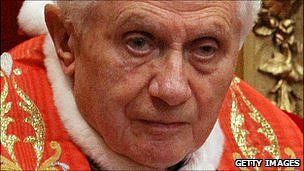
Pope Benedict XVI was tonight at the centre of a new diplomatic storm after Egypt recalled its ambassador to the Vatican in protest at the pontiff's call for Middle Eastern governments to do more to protect their Christian minorities.

Cairo's dramatic reaction came amid reports of a further attack in Egypt in which a Christian died. The interior ministry said an off-duty policeman boarded a train in southern Egypt and opened fire, killing a 71-year-old man and wounding five other Christians, including the dead man's wife. The attack raises fears of a new wave of rioting by Christians still mourning the deaths of at least 21 worshippers as they were leaving mass at a Coptic church in Alexandria on New Year's Eve.

In a statement, a spokesman for the foreign ministry said Cairo's ambassador had been called back for consultations "after the Vatican's new statements that touch on Egyptian affairs and which Egypt considers an unacceptable interference in its internal affairs".

In a speech to diplomats accredited to the Holy See on Monday, the pope said the Alexandria bombing, coming after a string of attacks in Iraq, showed "the urgent need for the governments of the region to adopt, in spite of difficulties and dangers, effective measures for the protection of religious minorities".

Quoting from a message agreed by a synod of bishops last year that discussed the situation of Christians in the Middle East, the pope said they were loyal citizens who were entitled to "enjoy all the rights of citizenship, freedom of conscience, freedom of worship and freedom in education, teaching and the use of the mass media". He also praised European countries who had asked for action by the European Union to protect Middle Eastern Christians.

The foreign ministry's protest was echoed by Sheikh Ahmed el-Tayyib, the imam of the Al-Azhar, the leading institute of Islamic learning in the Sunni Muslim world. He said: "Protection of Christians is an internal affair and should be carried out by the governments as [Christians] are their citizens like other citizens." He added: "We reiterate our rejection of foreign interference in the internal affairs of Arab and Islamic countries under whatever pretexts."

In Rome, a senior Vatican official, said Egypt's reaction was "the proof that the things said by the pope have hit the mark". Monsignor Jean-Louis Bruguès, stressed he was speaking in a personal capacity.

John Hooper in Rome
guardian.co.uk, Tuesday 11 January 2011 20.34 GMT

http://www.guardian.co.uk/world/2011/jan/11/pope-middle-east-christians-egypt


Share

Egypt recalls Vatican ambassador over Pope's remarks

Egypt has recalled its ambassador to the Vatican for consultation after Pope Benedict XVI urged the country to do more to protect its Christian minority.

In an address to ambassadors at the Vatican on Monday, the Pope cited recent attacks on Christians in Egypt and Iraq.

An Egyptian foreign ministry spokesman said the remarks were "unacceptable".

A bomb attack on a Coptic Christian church in Alexandria on New Year's Eve killed 23 people.

"Egypt asked its ambassador in the Vatican to come to Cairo for consultation after the Vatican's new statements that touch on Egyptian affairs, and which Egypt considers an unacceptable interference in its internal affairs," foreign ministry spokesman Hossam Zaki said in a statement.

There was no immediate official response from the Vatican. However, a Vatican source told AFP news agency that the recall did not constitute "a break in diplomatic relations".

In his address on Monday, the Pope condemned anti-Christian attacks in Egypt and Iraq, saying they showed "the urgent need for governments of the region to adopt... effective measures for the protection of religious minorities".

He also called on Pakistan to repeal its blasphemy laws, which can carry a death sentence for insulting the Prophet Muhammad.

It was not the first time the Pope had spoken out over the plight of Christian minorities in the Middle East.

In his traditional Christmas Day message - the Urbi et Orbi - he called for political leaders in the region to show solidarity with Christians.

And a day after the attack on the Coptic church in Alexandria, he appealed for the "concrete and constant engagement of leaders of nations" in what he called a "difficult mission".

On Sunday in an address in St Peter's Square, Rome, the Pope voiced solidarity with Egypt's Copts, saying: "I salute the Coptic faithful present here to whom I renew my expression of closeness."

Egypt's Coptic Christian minority makes up between 7% and 14% of Egypt's 80 million people.


http://www.bbc.co.uk/news/world-middle-east-12164696


Share

Egypt train attack: Man shot dead by off-duty policeman

An off-duty policeman has opened fire on a train in Egypt, killing a Christian man, but it is unclear whether the attack was sectarian.

At least another five people were reported to have been injured in the shooting on a train between Assiut and Cairo.

Officials said at least four of those hurt were Coptic Christians.

Witnesses said hundreds of Christians later clashed with police outside the hospital where the wounded were taken.

Police fired teargas to disperse them, reports from Samalut, in Minya province, said.

Tensions between Muslims and Christians in Egypt have been high following a bomb attack on a Coptic church in Alexandria at the new year that killed 23 people.

The gunman, who officials said had boarded the train at Samalut, has been arrested.

The Egyptian interior ministry named him as police officer Amer Ashour Abdel-Zaher. Officials have not given a motive for Tuesday's shooting.

The ministry statement said the officer "opened fire on some train passengers from his pistol and ran away", adding that he was later arrested at his home.

One of those injured was reported to be the dead man's wife.

Egypt's Coptic Christian minority is estimated to make up about 10% of Egypt's 80 million people, who are mostly Muslim.

The BBC's Jon Leyne reports from Cairo that it is difficult to see how the gunmen would have known he could target Christians by boarding the train.


http://www.bbc.co.uk/news/world-middle-east-12165523


Share

Ecumenical Prayer Service


Ecumenical Prayer Service for the Coptic Martyrs of Alexandria 1st January 2011.
St, Paul Anglican Cathedral 7th January 2011


Share

Copts celebrate but mourn


Share

Monday, January 10, 2011

Nativity Feast 2011 Divine Liturgy Sermon


Fr. Daniel Hanna Reads the Nativity Papal Message from H.H. Pope Shenouda III, and gives a sermon about being Rooted in Prayer, about the Gift of Salvation, and seeking God's will in our life

http://www.smsv.ca/


Share

Facebook Comments

Word of the Day

Quote of the Day

Article of the Day

This Day in History

Today's Birthday

In the News